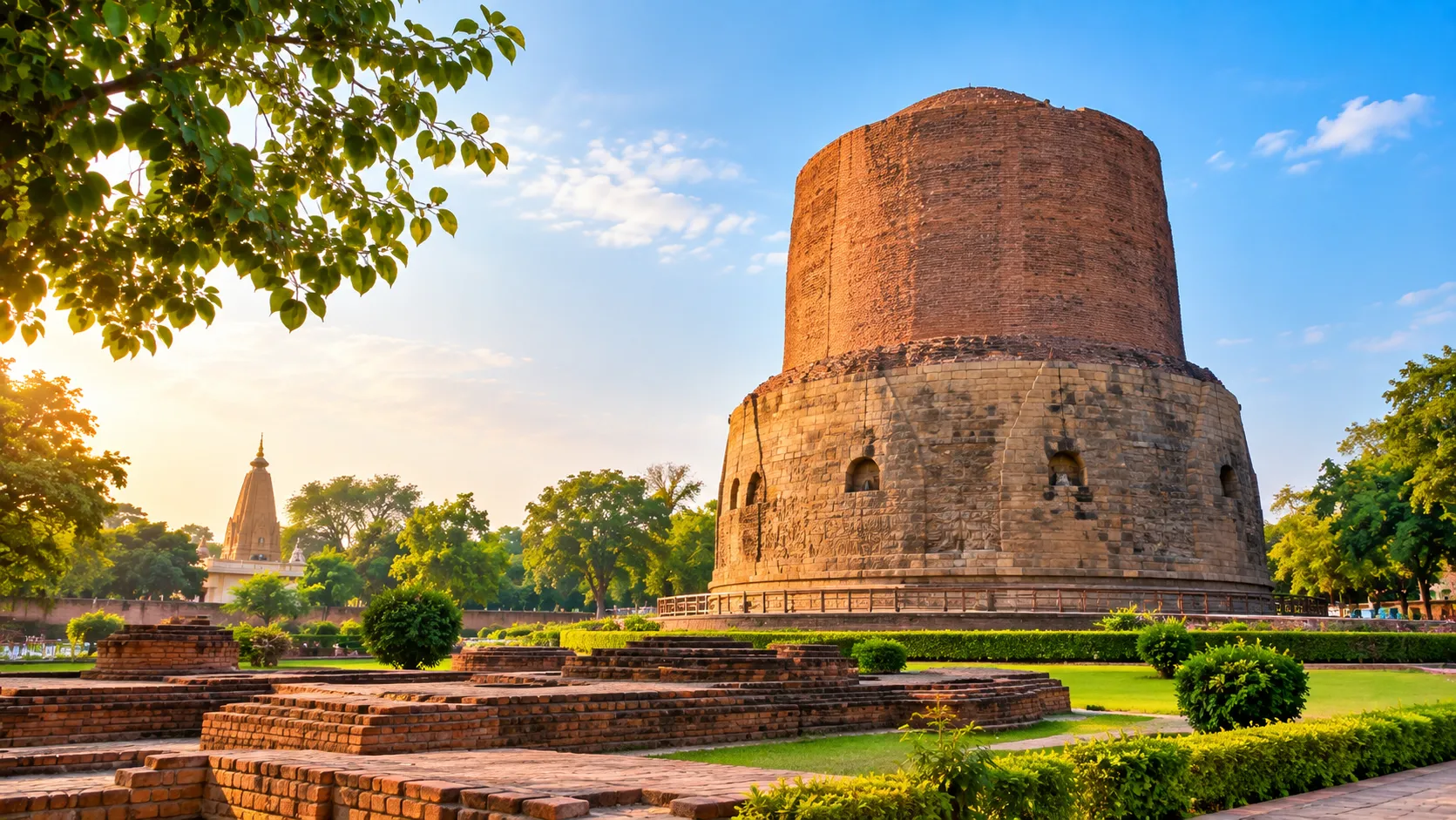
The Dhamek Stupa is the tallest and most recognizable monument in Sarnath, a small town about 10 km from Varanasi. It stands on the ground where, according to Buddhist tradition, the Buddha taught his first sermon after enlightenment. In July 2026 the wider Sarnath site was also added to the UNESCO World Heritage List, which has put the Dhamek Stupa back in the spotlight for travelers.
This guide covers what the stupa is, its history and design, Dhamek Stupa timings, the entry fee, the other sights around it, and how to fit Sarnath into a Varanasi trip. If you only want the basics for planning, jump to the timings and the half-day plan.
Dhamek Stupa at a Glance
| Detail | Information |
|---|---|
| Location | Sarnath, about 10 km from central Varanasi |
| Height | About 43 m (sources give slightly different figures) |
| Width at base | About 28 m |
| Material | Brick in the upper part, carved stone on the lower part |
| Linked to | The Buddha's first sermon |
| Best for | History, Buddhism, photography, a quiet half-day |
| Typical time needed | 1 to 2 hours for the stupa, 3 to 4 hours for all of Sarnath |
Why the Dhamek Stupa Matters
After attaining enlightenment at Bodh Gaya, the Buddha traveled to Sarnath, then known as the Deer Park at Isipatana. Here he is said to have taught the first five disciples, an event Buddhists call the turning of the wheel of dharma. That moment marks the start of the Buddhist community, so Sarnath ranks among the four most sacred Buddhist pilgrimage places, along with Lumbini, Bodh Gaya and Kushinagar.
The Dhamek Stupa is the main marker of that story. It is the first thing most visitors see when they enter the archaeological area, and it rises well above the ruins of old monasteries that surround it. Pilgrims walk around it clockwise, offer flowers and sometimes press gold leaf onto the stone.
History of the Dhamek Stupa
The base of the stupa goes back to the time of Emperor Ashoka in the 3rd century BCE. Ashoka built monuments across his empire to honor the Buddha's life, and Sarnath was one of the most important. The structure was expanded several times over the next centuries, and the form you see today is largely from the Gupta period, around the 5th century CE.
Sarnath later declined as Buddhism faded in the region, and for a long time the stupa stood as a mound among ruins. In the 19th century, British archaeologists began to explore the site. Alexander Cunningham, in the search for a relic casket, drilled a shaft from the top of the stupa. Large excavations followed in the early 20th century, which uncovered the remains of monasteries, temples and the famous Lion Capital of Ashoka.
Architecture and Design
The Dhamek Stupa is a solid cylindrical tower, not a building you can enter. The upper part is plain brick, while the lower part is covered in carved stone panels. Those carvings are one of the best things to look at closely.
- Floral and geometric patterns from the Gupta era, still visible along the lower band
- Carved figures of birds and humans
- Swastika motifs, an ancient auspicious symbol in Indian art
- Niches around the middle section, which once held images of the Buddha
Many stone sections have worn away, so the contrast between the rough brick above and the finer stonework below tells you how many times the monument was rebuilt. A slow walk around the base takes about 10 to 15 minutes and is worth doing.
Dhamek Stupa Timings
The monument is part of an archaeological area run by the Archaeological Survey of India, so it follows daytime hours. Sources list slightly different times, so use the table as a planning guide and confirm at the gate on your day.
| Place | Typical timing |
|---|---|
| Dhamek Stupa and the archaeological area | Around sunrise to sunset, often listed as 6 AM to 5 PM |
| Sarnath Archaeological Museum | Around 9 AM to 5 PM, closed on Fridays |
| Evening light and sound show | Around early evening, subject to availability |
The best time of day is early morning. The light is softer, the crowds are smaller and the temperature is far more comfortable, especially between April and June. For temple and monastery hours around Sarnath, our guide to Sarnath temple timings in Varanasi lists what is open and when.
Entry Fee
Reported ticket prices for the archaeological area are about ₹25 for Indian visitors and ₹300 for foreign visitors. The museum has its own, lower ticket. After the UNESCO listing, fees may be revised, so check the ticket counter when you arrive. Many of the monasteries and temples nearby are free to enter.
The Sarnath UNESCO World Heritage Listing
On 25 July 2026, the Ancient Buddhist Site of Sarnath was inscribed on the UNESCO World Heritage List at the 48th session of the World Heritage Committee in Busan. It became India's 45th World Heritage Site. The Dhamek Stupa, the Ashoka pillar remains, the Chaukhandi Stupa and the surrounding monastery ruins are part of the story of the site.
For travelers, the listing means more visitors, especially during the cooler months and Buddhist festivals. Expect busier mornings and weekends than before, and plan your visit for a weekday if you can.
Other Places Near the Dhamek Stupa
You can see most of these in one visit because they sit close together. For a short overview of the whole area, see our Sarnath places page.
Dharmarajika Stupa and monastery ruins
Just beside the Dhamek Stupa are the foundations of old monasteries and the remains of the Dharmarajika Stupa, which was built in the Ashokan period. The ruins show you how large the monastic community once was.
Mulagandhakuti Vihara
A modern temple built in the 20th century on the spot where the Buddha is believed to have spent a rainy season. The walls have murals of the Buddha's life, and the setting is quiet and calm.
Ashoka pillar remains
A broken section of the original Ashokan pillar still stands in the excavated area. The famous four-lion capital, which later became India's national emblem, was found here and is now kept in the museum.
Sarnath Archaeological Museum
This is one of the oldest site museums in India. Apart from the Lion Capital, it holds Buddha statues, carved panels and objects found during the excavations. Allow about an hour and remember that it is closed on Fridays.
Chaukhandi Stupa
A short distance from the main area, this brick mound marks the spot where the Buddha is traditionally said to have met his first disciples. An octagonal tower was added on top in the 16th century.
Thai Temple and the Buddha statue
A large Thai temple complex stands nearby and includes a tall standing Buddha statue. It is quiet and well kept, and makes a pleasant last stop.
A Half-Day Plan from Varanasi
Sarnath fits neatly into a half day, which makes it easy to combine with the city. This plan assumes you leave from central Varanasi by car or auto.
- 6:30 AM: Leave Varanasi. The drive to Sarnath takes about 25 to 40 minutes, depending on traffic.
- 7:15 AM: Walk around the Dhamek Stupa and the ruins while the light is soft.
- 8:30 AM: Visit Mulagandhakuti Vihara and the Thai Temple.
- 10:00 AM: Sarnath Museum (not on Fridays), then a simple breakfast.
- 11:30 AM: Return to Varanasi for lunch and rest.
You then have the afternoon and evening free for the city. A good pairing is to watch the Ganga Aarti in Varanasi later that day.
How to Fit Sarnath into a Varanasi Trip
Most travelers do Sarnath on the first morning of a two or three day trip, because it is calm and easy before the busy ghats. If you only have two days, our Varanasi trip plan for 2 days shows how to place it. With more time, the 3 days Varanasi itinerary gives Sarnath a comfortable slot. If you are not sure how long to stay, read how many days you need in Varanasi.
If you want everything arranged in one go, the 2 days Varanasi tour package can be adjusted to include Sarnath with transport and a local guide.
Best Time to Visit
October to March is the most comfortable period, with cool mornings and pleasant daytime weather. Summer afternoons are hot and the ground has little shade, so go early. Monsoon brings green lawns but wet paths. Buddha Purnima, in spring, is the busiest and most atmospheric day, with many pilgrims and special prayers. For more on the city side of your plan, see our guide to the best time to visit Varanasi.
Tips for Visiting the Dhamek Stupa
- Start early to avoid heat and crowds.
- Wear comfortable shoes, as the ground is uneven in the ruins.
- Carry water and a hat, because shade is limited.
- Dress modestly when entering temples and monasteries.
- Keep to the marked paths and do not climb on the stones.
- Hire a local guide if you want the story behind each ruin.
- Check museum timings if you plan to visit on a Friday.
Conclusion
The Dhamek Stupa is a short, rewarding visit that adds a very different side to a Varanasi trip. Go early, give it a slow walk around the base, and combine it with the museum and the nearby temples for a calm half day. With the new UNESCO status, Sarnath is likely to get busier, so a weekday morning is your best bet.
If you would like your Sarnath visit planned with a driver and a guide, contact our team and we will fit it into your Varanasi stay.