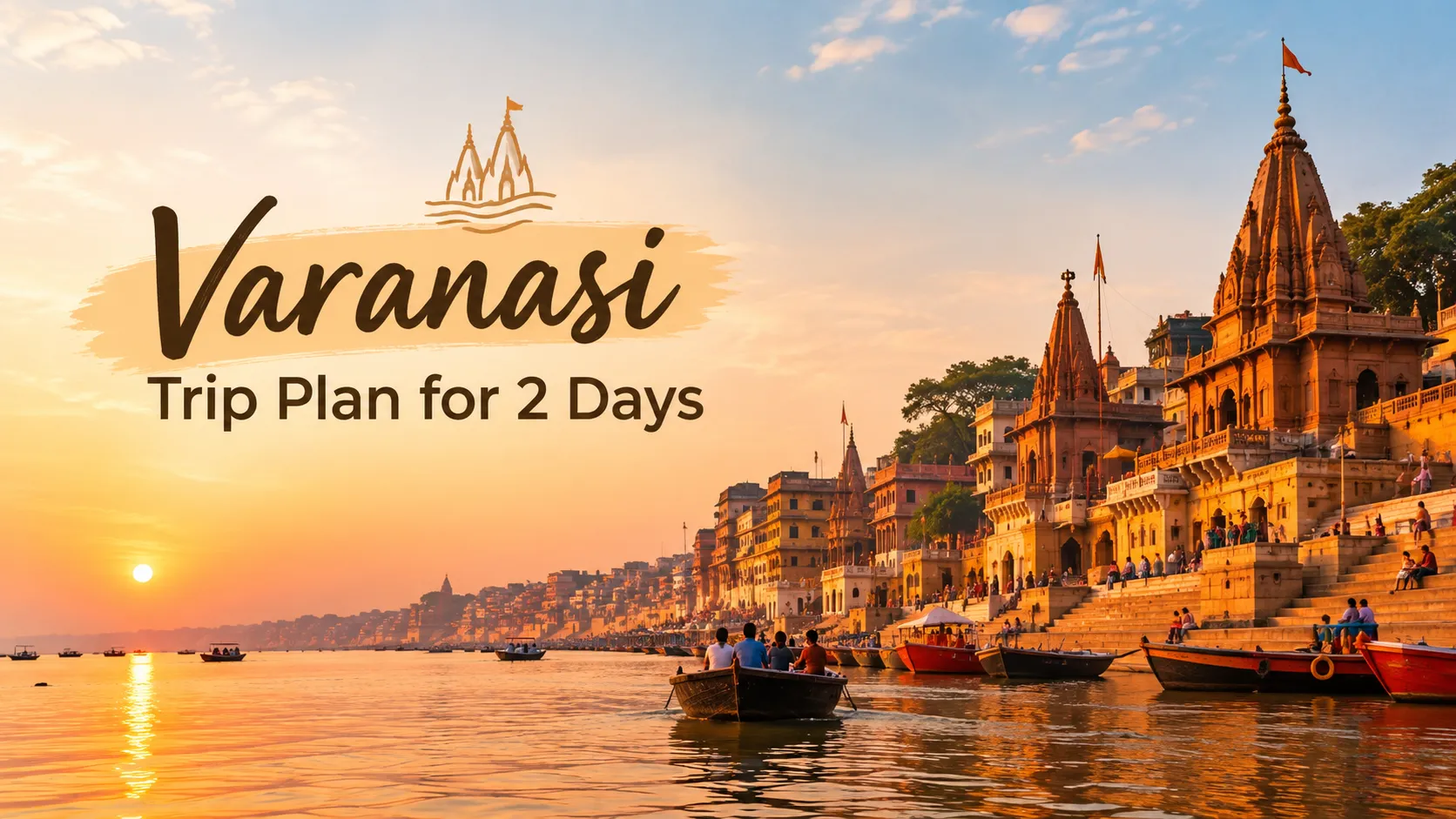
Varanasi Trip Plan for 2 Days: The Complete First-Timer's Itinerary
If you've got 48 hours and you're trying to figure out a Varanasi trip plan for 2 days that actually works on the ground (not just on paper), you're in the right place. Varanasi is not a city you "see." It's a city you move through, at odd hours, often on foot, often lost. Two days is tight, but it's genuinely enough to walk away with the boat ride, the temple, the aarti, and a day trip to Sarnath, if you plan the hours instead of just the places.
This guide breaks the trip down by clock time, not just a list of attractions, because that's where most 2-day plans fall apart. People land at noon, add up eight things from a blog post, and realize by evening they've only managed three.
Want someone else to handle the logistics for you?
Get in touch with us and we'll sort the boat, the guide, and the transfers so you can just show up.
Is 2 Days Really Enough for Varanasi?
Honestly, yes and no. Two days is enough to hit the essentials: a sunrise boat ride, Kashi Vishwanath darshan, the evening Ganga Aarti, and a half-day at Sarnath. What you won't get is slow time. There's no room for a lazy afternoon nap, a second wander through the old city lanes, or a day trip to Ramnagar Fort. If your trip is packed between two other cities (say, Delhi and Bodh Gaya, or Agra and Kolkata), 2 days does the job well.
Best Time for a 2-Day Varanasi Trip
October to March is the sweet spot. Mornings are cool enough that the 5 AM boat ride doesn't feel like a punishment, and daytime temperatures stay comfortable for walking around temples and ghats. December and January can get foggy and genuinely cold before sunrise, so pack a jacket even if you're used to Indian winters elsewhere.
April to June is hot, often above 40°C by midday, which squeezes your sightseeing into early morning and evening slots. July to September brings the monsoon: the Ganga rises, some ghat steps disappear underwater, and boat routes get restricted for safety. It's atmospheric if you don't mind humidity and the occasional downpour, but it does change how a 2-day plan plays out.
If your dates line up with Dev Diwali (around Kartik Purnima, usually November) or Mahashivratri (February or March), the city turns into something else entirely: lakhs of extra diyas, huge crowds, and higher hotel prices. Worth it if that's the experience you want, but book everything well in advance.
Getting to Varanasi
By Air
Lal Bahadur Shastri International Airport (VNS) has regular flights from Delhi, Mumbai, Bengaluru, and a growing list of other cities. It's about 45 minutes to an hour from the city center by prepaid taxi.
By Train
Varanasi Junction (Varanasi Cantt) and Banaras (BSB) stations are well connected to Delhi, Kolkata, Mumbai, and Patna, including several overnight trains, which is a smart way to save a hotel night if your trip is short on time.
By Road
If you're coming from Ayodhya, Prayagraj, or Lucknow, the drive is manageable in half a day and works well if you're stringing together a pilgrimage circuit.
Whichever way you arrive, try to reach Varanasi by the evening of Day 0 or early morning of Day 1 so you don't lose your first sunrise slot.
Day 1: Hour-by-Hour Varanasi Itinerary
5:00 AM – Sunrise Boat Ride from Assi or Dashashwamedh Ghat
This is the one thing almost every good Varanasi itinerary agrees on, and for good reason. The ghats at dawn are quiet, the light is soft, and you'll pass priests setting up for morning rituals, people bathing, and the occasional funeral pyre still burning from the night before. Boats leave from Assi Ghat or Dashashwamedh Ghat and typically cover the stretch up to Manikarnika Ghat and back in about an hour.
Negotiate the price before you get in, or better, book through your hotel or a package in advance so you're not haggling half-asleep at 5 AM. If you'd rather not deal with any of this, our 2-day Varanasi tour package already includes the boat, so it's booked before you land.
6:30 AM – Subah-e-Banaras at Assi Ghat
If your boat ride ends near Assi Ghat, stick around for Subah-e-Banaras, the morning aarti offered to the rising sun and the river. It's less crowded and less touristy than the famous evening version, and it's a nice, quiet way to close out your sunrise hours.
8:00 AM – Breakfast and Freshen Up
Head back to your hotel or grab breakfast at one of the cafés near the ghats. Kachori-sabzi and a glass of hot, thick Banarasi lassi are the local move if you want to eat like you're actually in Varanasi and not at a hotel buffet.
9:30 AM – Kashi Vishwanath Temple Darshan
This is the spiritual centerpiece of the city, and it deserves a slot when the crowds have thinned slightly from the pre-dawn rush but before the midday queues build up again. Leather items (belts, wallets, shoes) aren't allowed inside, phones need to be deposited at the counters outside, and there's a dress code, so modest clothing is a good idea regardless. Expect security checks similar to an airport given the temple's location right next to the Gyanvapi complex.
If you want a faster, less crowded entry, ask about Sugam Darshan at the counter. It costs more than the free general queue but can save you a significant amount of standing time, which matters a lot when your whole trip is 2 days.
11:30 AM – Explore the Old City Lanes
The gali (lane) network around Vishwanath Gali is where Varanasi actually feels like Varanasi: narrow enough that two people can barely pass, lined with shops selling Banarasi silk, brass idols, and bead malas, with the occasional stray cow blocking the entire street like it owns the place (it kind of does). Give yourself an hour here without a fixed plan. Getting mildly lost is part of the experience.
1:00 PM – Lunch
Try a thali at a local eatery, or if you're craving something lighter, Varanasi's street food scene around Godowlia is hard to beat: chaat, jalebi, and the famous Banarasi paan to finish.
2:30 PM – Rest or Optional Temple Visits
Use this slot as a buffer. If you're tired from the early start, this is your window to nap or shower. If you've got energy left, visit Kaal Bhairav Temple or Durga Kund Temple, both a short auto ride away.
5:30 PM – Head to Dashashwamedh Ghat Early
The evening Ganga Aarti is the single most crowded event in the city, and arriving even 30-45 minutes early is the difference between a clear view of the priests and lamps versus watching the backs of other people's heads. Timing shifts slightly by season, generally around 6:45 PM in winter and closer to 7 PM in summer, so check locally on the day.
For a genuinely better view, book a boat and watch the aarti from the river instead of the crowded ghat steps. It's calmer, cooler, and honestly more atmospheric with the flames reflecting on the water.
8:00 PM – Dinner and Wind Down
Rooftop restaurants overlooking the ghats are everywhere in this part of town. Pick one, order something simple, and let Day 1 end slowly.
Day 2: Hour-by-Hour Varanasi Itinerary
7:30 AM – Breakfast, Then Head to Sarnath
Sarnath is about 10 km from central Varanasi and roughly a 30-minute drive. This is where Buddha gave his first sermon after attaining enlightenment, and it's one of the four major Buddhist pilgrimage sites. Plan on 2-3 hours here to cover the Dhamek Stupa, the archaeological museum, and a couple of the international temples (the Thai and Japanese temples are particularly striking).
11:00 AM – Back to Varanasi, Visit BHU and Nearby Temples
Banaras Hindu University's campus is worth a drive-through even if you're not stepping into every building, and the New Vishwanath Temple (also called Birla Temple) inside the campus is open to all faiths and rarely crowded. If time allows, Sankat Mochan Hanuman Temple and Tulsi Manas Mandir are close by and easy to combine.
1:00 PM – Lunch
Grab something near the university area or head back toward Godowlia for one last round of street food before you leave.
2:30 PM – Shopping and Last Walks
Pick up Banarasi silk sarees, wooden toys, or brass items from the markets around Vishwanath Gali or Thatheri Bazaar (the latter is known specifically for metalwork). This is also a good slot for photos you didn't get time for on Day 1.
5:00 PM – Sunset at the Ghats or Second Boat Ride
If your departure allows, catch the ghats one more time at golden hour. It's quieter than the aarti crowd and a nice, low-key way to close out the trip.
Evening – Departure
Give yourself real buffer time to reach the airport or railway station, especially if you're traveling during festival season when roads near the ghats get congested.
Varanasi 2-Day Trip Budget: What It Actually Costs
Costs vary a lot by hotel category, but here's a realistic range per person for a 2-day, 1-night trip, assuming shared transport and mid-range choices:
| Category | Approx. Cost (2 Days, per person) |
|---|---|
| Budget (hostel/guesthouse, shared auto, street food) | ₹2,500 – ₹4,000 |
| Mid-range (3-star hotel, private cab for sightseeing, sit-down meals) | ₹6,000 – ₹10,000 |
| Comfort/Private (4-star hotel, private boat, guided darshan) | ₹12,000 and up |
This excludes flights or long-distance trains to reach Varanasi. Boat rides, temple donations, and Sugam Darshan tickets (if you choose the paid queue) are the variables that shift your total the most.
1 Night 2 Days vs 2 Nights 2 Days: Which Should You Pick?
This trips people up more than it should. A "1 night, 2 days" trip means you arrive Day 1 evening, stay one night, and leave Day 2 evening or night, giving you roughly one full day plus two partial ones. A "2 nights, 2 days" trip gives you two full days between two nights of sleep, which is noticeably less rushed, especially for the early sunrise starts on both mornings.
If your schedule allows, 2 nights is the more comfortable option. If you're squeezing Varanasi between two other destinations, 1 night works, just don't plan anything ambitious for your arrival evening.
Practical Tips for a Smooth Trip
- Luggage before checkout: Since the best boat ride is before sunrise, ask your hotel if you can store bags and do a late checkout, or check out the night before and keep luggage at the front desk.
- Cash matters: Many boatmen, small shops, and roadside food stalls don't take cards. Carry enough cash for the day.
- Dress modestly: Especially for temple visits. Shoulders and knees covered is a safe default for any gender.
- Footwear: You'll remove shoes often (temples, some ghats). Slip-on shoes save a lot of hassle.
- Walk, don't drive, through the old city: Cars can't get through most of the lanes anyway. Budget extra walking time.
- Solo travelers: Varanasi is generally safe, including for solo women, but stick to well-lit ghats after dark and agree on boat and auto prices upfront.
- Skip Manikarnika Ghat photography: It's a working cremation ground. Locals are understandably not okay with tourists photographing it, and some areas restrict cameras entirely.
Want More Time in Varanasi?
If reading through this makes you want to slow down rather than rush, it might be worth stretching your trip. Our 3-day Varanasi itinerary adds breathing room for a proper Ramnagar Fort visit, a second early morning at the ghats without the packing-and-leaving pressure, and more time in the old city lanes.
Conclusion
Two days in Varanasi will feel full, occasionally chaotic, and honestly a little emotional in places you won't expect, usually somewhere on that early boat ride when the city is still half-asleep and the temple bells start anyway. Plan the hours, not just the sights, keep your mornings early, and you'll leave with a real sense of the city rather than a checklist. If you'd rather hand off the planning altogether, our team can put together a 2-day Varanasi trip built around exactly this rhythm, just reach out and we'll take it from there.