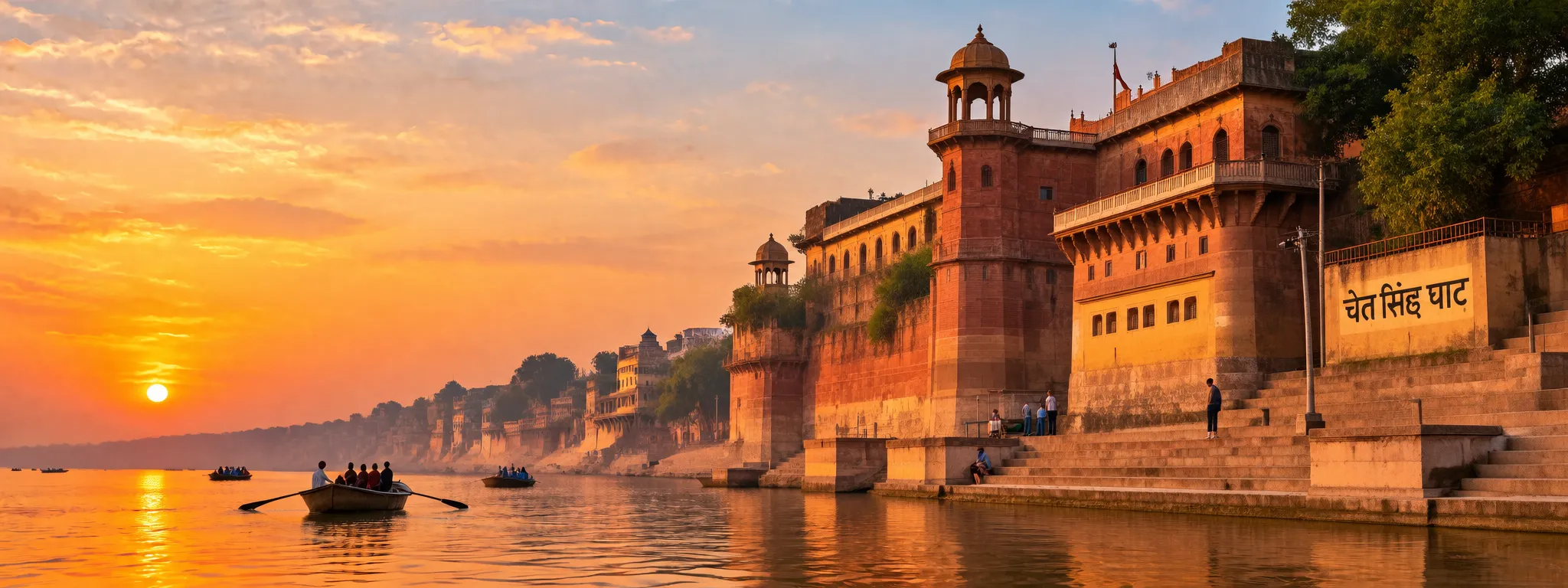
Chet Singh Ghat is the ghat in Varanasi with a fort rising straight out of the river. Its tall walls, bastions and grand gateway look more like a Rajasthani palace than a pilgrim ghat, and it is tied to one of the most dramatic moments in Banaras history, the 1781 clash between Raja Chait Singh and Warren Hastings.
Most people only see it from a boat and wonder what the story is. This guide explains the history, what you can actually see, the evening light and sound show, why the ghat has so many names and how to reach it.
Is Chet Singh Ghat Worth Visiting?
Short answer: yes, if you like history, photography and quieter river views. No, if you only want temples and aarti.
| You will enjoy it if | You may skip it if |
|---|---|
| You like forts, old architecture and photography | You want a major temple darshan |
| You want a calmer ghat than Dashashwamedh | You are short on time and have only one evening |
| You enjoy history stories told with sound and light | You want to go inside a fort museum |
| You are doing a sunrise or sunset boat ride | You dislike steps and uneven ground |
The Story Behind Chet Singh Ghat
The ghat and the fort above it were built in the mid-18th century by Raja Balwant Singh, the founder of the Benares state, with the help of his engineer Baijnath Mishra. At that time the place was known as Shivala Ghat, after the locality.
His son, Raja Chait Singh (also written Chet Singh), took the throne in 1770. By then the British East India Company, led by Governor-General Warren Hastings, was demanding heavy payments and extra war taxes, and asked him for 2,000 horsemen. Chait Singh did not meet the demand in full. In August 1781, Hastings came to Banaras to confront him and tried to put him under arrest.
What followed became a local legend. Chait Singh's men rose against the Company's soldiers at the ghat and the fort. The Raja escaped across the river to Ramnagar, and Hastings himself was forced to leave Banaras and take shelter at Chunar. A folk rhyme about Hastings fleeing "on an elephant with the saddle on the wrong side" still circulates in Varanasi.
The uprising did not last. The British later removed Chait Singh and placed his nephew, Mahip Narayan Singh, on the throne. The fort passed out of the family, and it was only in the 1890s that Maharaja Prabhunarayan Singh recovered it. That is why the ghat now carries Chait Singh's name instead of Shivala.
What You Can Actually See
The fort from the river
This is the best view. The fort rises above the ghat with a large buttress on the south side, a huge entrance on the north and two bastions above the gate. A Rajput-style barahdari (open pavilion) stands inside. From a boat, the whole structure looks like a piece of Rajasthan dropped onto the Ganga.
The ghat steps
The steps are broad and quiet in the daytime. It is a good place to sit, watch the river and take photos at sunrise, when the light turns the stone gold.
Shiva temples on the ghat
Three old Shiva temples, dated to the 18th century, stand near the ghat. They are small and calm, and give the place a devotional side.
Entry to the fort
Much of the fort is part of the Kashi royal family's property, and access can be limited. Treat it mainly as something to admire from the ghat and the water, and ask locally before you plan to go inside.
The Light and Sound Show
In the evening, the fort comes alive with a light and sound show that tells the story of Banaras and the battle of 1781. Visitors describe the ghat as busy at that time, since people gather to watch it, and it is a good way to understand the history in a short time.
Show timings, language and tickets can change, and the show may not run every day or in bad weather. Check the current schedule locally or with your driver before you plan your evening around it. If you are also planning the main aarti, see our guide to Dashashwamedh Ghat and decide which evening suits each one.
Why Does Chet Singh Ghat Have So Many Names?
This confuses many visitors. Here is the short version.
| Name | What it means |
|---|---|
| Shivala Ghat | The original name, after the locality and its Shiva temples |
| Chet Singh Ghat | The part with the fort, renamed after Raja Chait Singh |
| Khirki Ghat | An older nickname, linked to the windows (khirki) of the fort |
| Niranjani Ghat and Nirvani Ghat | Neighboring sections that are now grouped with it |
Today the whole stretch is often described as one ghat divided into four parts: Chet Singh, Niranjani, Nirvani and Shivala. So if a boatman or a map uses one of these names, you are still in the same area.
Culture and Festivals
In the first half of the 20th century, this ghat hosted the Budhwa Mangal festival, a seven-day celebration. Today the biggest occasion is Dev Deepawali, when the fort and the steps are lit with thousands of lamps and the view from the river is extraordinary. Dev Deepawali is on 24 November 2026, and you can read how we plan it in our Dev Deepawali package.
How to Reach Chet Singh Ghat
Chet Singh Ghat is on the southern side of the old city, about 2 km from Dashashwamedh Ghat and about 5 km from Varanasi Junction.
- By road: Take a car, auto or e-rickshaw toward Shivala, then walk down to the ghat.
- By boat: Easy from any main ghat. Many sunrise and sunset rides pass it.
- From the south ghats: It is a pleasant walk from Assi or Tulsi Ghat in the morning. See our guide to Tulsi Ghat for what to see on that stretch.
For boat prices, timings and how to avoid overcharging, read our Varanasi boat ride price and booking guide.
A Simple Plan for Chet Singh Ghat
- Sunrise: Take a boat from a nearby ghat and view the fort in morning light.
- Mid-morning: Walk the ghat steps and visit the old Shiva temples.
- Evening: Return for the light and sound show, if it is running that day.
If you want to pair it with another ghat, our guide to Kedar Ghat covers a calmer, temple-focused stop nearby. For a complete route along the riverfront, see our guide to the ghats in Varanasi.
Best Time to Visit
Early morning is best for photos and a quiet atmosphere. Evenings are lively, especially when the show runs. October to March is the most comfortable season, and summer afternoons are hot with little shade. Festival nights, especially Dev Deepawali, are the most beautiful but also the most crowded. Our best time to visit Varanasi guide explains the seasons.
Tips for Visiting
- Go by boat for the best view of the whole fort.
- Wear shoes with a good grip, as the steps can be wet and uneven.
- Keep your phone and wallet secure during the evening crowd.
- Check show timings before you travel, and arrive 20 to 30 minutes early.
- Agree on the boat price, route and duration before you board.
- Respect people who are bathing or praying, and ask before taking their photo.
- Do not climb on the fort walls or enter closed areas.
Add Chet Singh Ghat to Your Varanasi Plan
Most travelers see it as part of a river trip, with a sunrise boat ride or an evening stop. If you want your driver, boat and guide arranged together, our 2 days Varanasi tour package can include a riverfront morning that covers Chet Singh Ghat.
Conclusion
Chet Singh Ghat is the history chapter of Varanasi's riverfront. See the fort from the water at sunrise, learn the 1781 story, and if the schedule allows, return for the light and sound show.