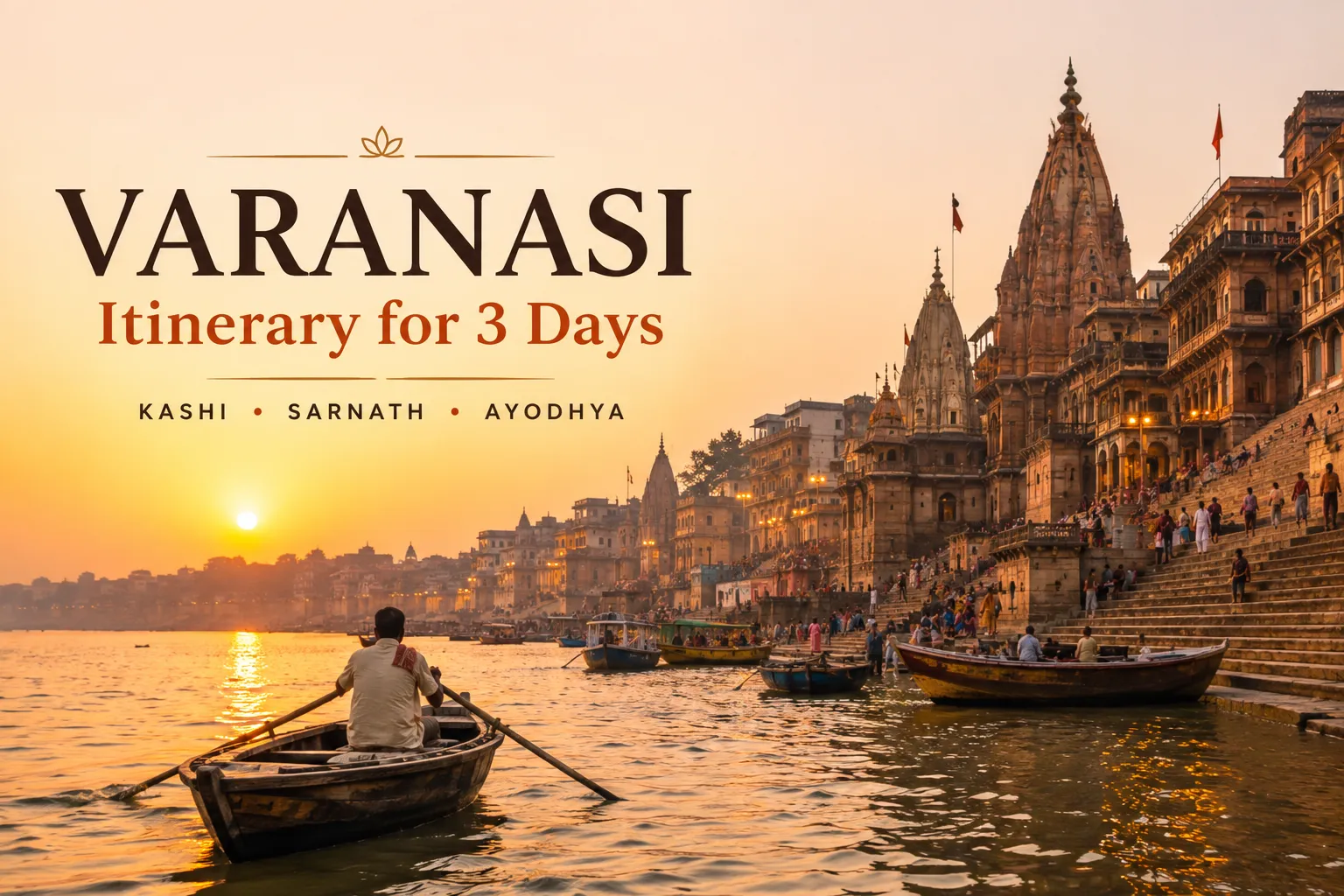
Varanasi Itinerary for 3 Days: Kashi, Sarnath and the Ayodhya Add-on (2026)
Varanasi doesn't hand itself over easily. You can land, do a sunrise boat ride, watch one aarti, and leave feeling like you saw a highlight reel instead of the actual city. Give it three days, though, and something shifts. The chaos starts making sense. You stop flinching at the cremation ghats and start understanding why they're there. Honestly, three days is the point where Varanasi stops being a checklist and starts being a place.
This guide covers the full range, whether you've got just one day squeezed between meetings, a quick weekend, or the full three days that actually let the city breathe. If you're specifically planning a Varanasi itinerary for 3 days, this is built to be your single reference: what to do, what it costs, and the one question almost every 3-day itinerary online dodges — can you really add Ayodhya without wrecking the pace?
Want someone to just handle the logistics for you?
Drop us a line here and we'll build your dates around it.
So how many days do you actually need?
Let's clear this up first, because the honest answer depends entirely on what you want out of the trip.
one day trip to Varanasi
works if you're passing through, on a business layover, or just curious and short on time. You can realistically cover Kashi Vishwanath Temple, a walk through the ghats, and the evening Ganga Aarti at Dashashwamedh Ghat. You won't get Sarnath in, and the boat ride will feel more like a box you tick than something you sit with. It's not a bad trip. It's just an appetizer.
2 day trip to Varanasi
is where things start to feel complete rather than rushed. Day one covers the temples, ghats and evening aarti. Day two gives you a proper sunrise boat ride, a visit to Sarnath, and time in the old city lanes and the silk market. Most weekend travelers land here, and it's genuinely a solid, unhurried two days.
3 day trip to Varanasi
is where you stop compressing. You get the temples and the aarti without racing the clock, a full morning for the boat ride instead of a squeezed hour, a real Sarnath visit rather than a drive-by, and a third day that most people skip entirely: the quiet ghats, the artisan lanes, the street food trail that only shows up once you're not sprinting anywhere. Three days is also the minimum you need if you're seriously considering the Ayodhya add-on, and we'll get into exactly why below.
The real 3-day Varanasi itinerary
Here's how we'd actually structure a Varanasi 3 days itinerary, based on what's realistic to see without burning out by day two.
Day 1: The city introduces itself
Land in Varanasi and check into a hotel near Sigra or Godowlia, both put you within easy reach of the ghats without dealing with a long auto ride every time you want to step out. Spend the afternoon easing in rather than sightseeing hard, Varanasi's energy hits differently the moment you step off a flight or train, and rushing straight into the crowds tends to backfire.
By late afternoon, head to Kaal Bhairav temple first. There's a local belief that you're meant to seek his blessing before Kashi Vishwanath, so most guides build the day around that order. From there, Annapurna Devi temple and Vishalakshi temple are a short walk apart. As evening sets in, make your way to Dashashwamedh Ghat for the Ganga Aarti. Get there at least 30 to 40 minutes early if you want a decent view, the crowd builds fast and it's genuinely one of those things where being ten minutes late means watching over someone's shoulder.
Day 2: The river and Sarnath
This is the day that makes the whole trip worth it. Get down to the ghats by 5:30 AM, before the city fully wakes up. Board a boat at Assi Ghat or Dashashwamedh Ghat and drift north along the riverfront for close to 90 minutes. The sky changes from grey to pink to gold while you watch. Smoke rises from Manikarnika, the burning ghat, temple bells ring out over the water, and there's genuinely nothing else in India that sounds quite like it.
After breakfast, head to Sarnath, about 10 km and roughly 20 to 30 minutes away by cab. This is where Buddha delivered his first sermon after enlightenment, and the Dhamek Stupa marks the spot. The archaeological museum next door holds the Ashokan lion capital, which is worth the visit on its own. Come back into the city for lunch, then spend the afternoon in the Banarasi silk market or just wandering the narrow lanes. Round off the evening with a second aarti viewing, this time try Assi Ghat instead of Dashashwamedh for a quieter, more local feel.
Day 3: The quiet side of Kashi, or the road to Ayodhya
This is the day where your plan splits, and we'll walk you through both options honestly below.
If you're staying in Varanasi, use day three for the parts most tourists never see. Kedar Ghat and Tulsi Ghat in the early morning are far calmer than the main ghats. Banaras Hindu University and its Vishwanath temple are worth a couple of hours, and Ramnagar Fort on the eastern bank makes for a good sunset stop with a boat crossing to get there. This is also your day for the street food trail, kachori sabji and jalebi for breakfast, tamatar chaat in the afternoon, and a proper Banarasi paan before you leave.
If you're adding Ayodhya, this is the day it happens, and it takes the whole day.
The honest answer on the Ayodhya add-on
Most 3 days itinerary for Varanasi and Ayodhya pages you'll find online quietly list Ayodhya as a day-three add-on next to Sarnath and the ghats, as if it's just another stop. It isn't, and we'd rather tell you that upfront than have you find out mid-trip.
Varanasi to Ayodhya is about 220 km by road, roughly 4 to 4.5 hours each way via Sultanpur and Jaunpur. Some operators run this as a day trip, leaving Varanasi early morning and returning late night, but that means close to 8 to 9 hours on the road alone, layered on top of whatever time you actually spend in Ayodhya seeing Ram Janmabhoomi, Hanuman Garhi and the Saryu Aarti. It's doable. It's just not restful, and if you've already done two full days of sightseeing in Varanasi, day three on a bus is a rough way to end the trip.
The cleaner way to do it, and what we'd genuinely recommend, is to treat Ayodhya as an overnight extension rather than a same-day round trip. Spend day three traveling to Ayodhya in the morning, catch the Ram Janmabhoomi darshan and the evening Saryu Aarti, stay the night there, and head back the next day. That turns your "3-day Varanasi trip" into a 4-day Varanasi-Ayodhya trip, which is a more honest way to plan it than pretending you can do both cities properly in three days flat.
If Ayodhya matters to you but you don't want to stretch the trip, the trade-off is usually Sarnath. Some travelers skip Sarnath on day two, do a longer day-trip loop to Ayodhya on day three instead, and accept that they're seeing less of Varanasi itself in exchange for covering both cities. Neither choice is wrong. It just depends on what you came for. We'd rather you make that call knowing the real math than get surprised by it on the road.
We've built a version of this exact plan as a proper package if you'd rather not sort out drivers and hotel timing yourself. Take a look at our 3-day Varanasi tour package for the version that keeps Sarnath in and the pace comfortable.
What it actually costs
Numbers here are based on current 2026 local rates, not vague "starting from" figures.
Local cab (private, per day): A sedan for a half-day (4 to 5 hours) runs roughly ₹1,800 to ₹2,500. A full day covering the whole city circuit including Sarnath typically costs ₹2,200 to ₹4,000, depending on whether you go sedan or Innova. Split across a group of four, that's often under ₹700 per person for the whole day.
Boat ride: Expect to pay somewhere between ₹800 and ₹1,500 for a sunrise or aarti-time boat ride, depending on group size and whether you're on a shared boat or a private one.
Guide fees: If you want a local guide rather than navigating temple order and timing yourself, budget ₹1,600 to ₹2,500 for a full day.
Ayodhya add-on (if going by road): A private cab for the Varanasi to Ayodhya round trip, including waiting time, generally falls in the ₹6,000 to ₹9,000 range depending on vehicle type, on top of your Ayodhya hotel night if you're staying over.
None of this includes temple donations, meals, or shopping, which genuinely vary too much person to person to put a number on.
Three days in Varanasi is enough to let the city move past the postcard version and actually get under your skin, the smoke over the ghats, the bells at dawn, the paan-stained smiles in the old lanes. However you choose to spend your days here, it's a trip that tends to stay with people long after they've left. If you'd like help turning this plan into an actual booking, dates, hotel, driver and all, have a look at our Varanasi tour packages and we'll take it from there.