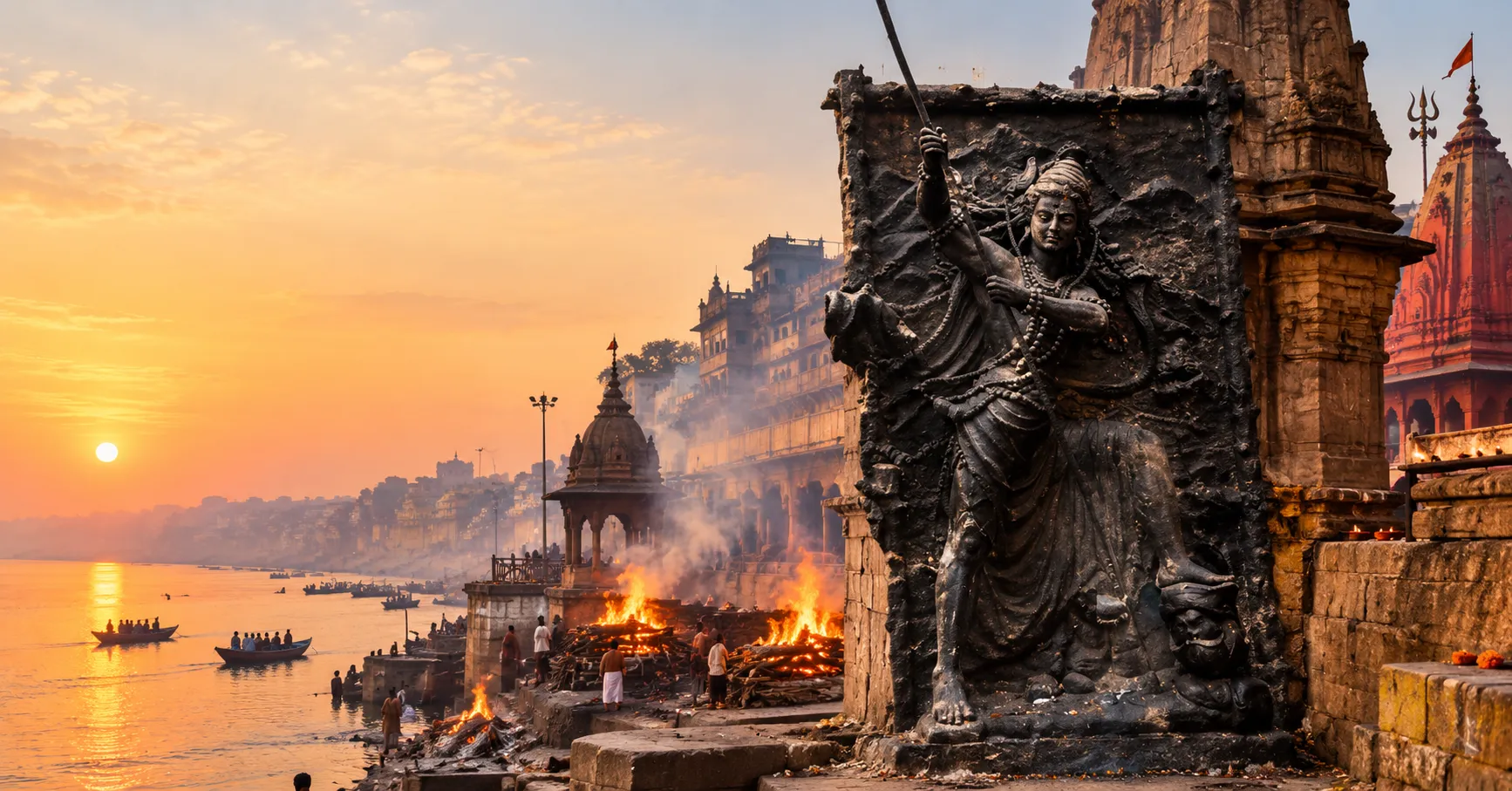
Manikarnika Ghat is the most sacred cremation ground in Varanasi, known as the Mahashmashan, or the Great Cremation Ground. Hindus believe that being cremated here, in the holy city of Kashi, brings moksha, the release from the cycle of birth and death. The ghat is also one of the oldest on the Ganga, with legends tied to Shiva, Parvati and Vishnu.
Many visitors want to see Manikarnika Ghat but are unsure what to expect or how to behave. This guide explains the Manikarnika Ghat story, its history, what you will see, the rules to follow and the best way to visit with respect.
Manikarnika Ghat at a Glance
| Detail | Information |
|---|---|
| Location | Lahori Tola area, between Dashashwamedh Ghat and Scindia Ghat |
| Known as | Mahashmashan, the Great Cremation Ground |
| Meaning of the name | Mani means jewel and karnika means earring |
| Sacred pond | Manikarnika Kund, also called Chakra Pushkarini |
| Open | Cremations continue day and night |
| Entry fee | None |
| Photography | Not allowed near the cremations |
| Best way to see it | By boat, or with a respectful guided walk |
Manikarnika Ghat Story: The Legends Behind the Name
The name Manikarnika comes from the story of a jeweled earring. There are a few versions, and all of them are part of the tradition.
In the most common account, Lord Vishnu created a sacred pond here with his discus so that Shiva and Parvati could bathe in it. While they were at the pond, an earring fell into the water, and the place was named Manikarnika. In another version, it was Shiva's jewel and Parvati's earring that together gave the place its name, and in some retellings Parvati hid her earring so that Shiva would stay in Kashi.
A second, deeper belief explains why people want to be cremated here. It says that Lord Shiva himself whispers the Taraka Mantra, the mantra of liberation, into the ear of the departed soul at this ghat. That belief is why the place is called the giver of liberation and why families travel long distances to perform the last rites here.
History of Manikarnika Ghat
Manikarnika is among the oldest ghats in Varanasi. A Gupta period inscription from around the 5th century mentions it, which shows how long the place has been known. The ghat is described in the Kashi Khanda of the Skanda Purana, which praises Kashi as a city of liberation.
The ghat you see today is largely the result of rebuilding in the 18th century, when Maratha and other rulers renewed the riverfront. Queen Ahilyabai Holkar of Indore built the Tarakeshwar temple here in 1795. Another small temple was built by Maharaja Mangal Singh of Alwar in 1895. The ghat has changed over time, and redevelopment work in the area means the surroundings can look different from one year to the next, so check the situation before you go.
What You Will See at Manikarnika Ghat
The cremation pyres
Fires burn here throughout the day and night, and many believe the flame has never gone out. Wood is stacked in tall piles near the steps, and families bring the body, wrapped in cloth and flowers, down to the river. The process is quiet and structured. The Dom community, who tend the fires, have done this work for generations.
Manikarnika Kund
The kund, or sacred pond, is the original heart of the ghat. It is also known as Adi Manikarnika Tirth and Chakra Pushkarini. A set of steps leads down to it. Near the kund, you can see marks that devotees consider to be Vishnu's footprints.
The leaning Ratneshwar Mahadev temple
Next to the ghat is a small Shiva temple that leans toward the river. It has stood at this angle since the early 19th century, and it is one of the most photographed sights from a boat.
Tarakeshwar and other shrines
The Tarakeshwar temple, whose name means "Lord of Crossing," is linked with the Taraka Mantra. Other small shrines stand along the steps and in the lanes above the ghat.
Manikarnika Ghat and Harishchandra Ghat
Varanasi has two main cremation ghats. Manikarnika is the busiest and the most sacred, and Harishchandra Ghat is the second. Both are active day and night. Many people ask which to visit, and the simplest answer is that you can see both from the river, and you do not need to go closer than you feel comfortable with.
Masan Holi
Around the time of Holi, a special ritual known as Masan Holi takes place near the ghat. Devotees of Shiva play with ash from the pyres in the belief that Shiva celebrates Holi with the departed. It is a unique, intense event, and it is crowded. If you want to attend, go with a local guide and keep a respectful distance.
Rules and Etiquette for Visiting
Manikarnika Ghat is a place of grief and ritual for many families, so follow these rules.
- Do not take photos or videos of the cremations, the mourners or the pyres.
- Do not fly a drone.
- Keep your voice low, and do not laugh or joke near the pyres.
- Dress modestly, in simple clothes that cover shoulders and knees.
- Do not touch the wood, the pyres or the bodies.
- Stay out of the way of funeral processions, and step aside when you see one.
- Do not give money to people who claim you must "donate for wood" or "pay for entry." There is no entry fee. If a stranger insists, politely decline and walk away.
- Hire a licensed guide or book a reputable boat or tour, rather than following people who approach you in the lanes.
How to Visit Manikarnika Ghat
By boat
This is the most comfortable and respectful way for most visitors. You pass the ghat at a distance, see the pyres and the leaning temple, and avoid the narrow lanes. A sunrise or evening boat ride works well. Our Varanasi boat ride price and booking guide explains how to book a safe, fair-priced ride.
On foot with a guide
The ghat is reachable through the lanes of the old city, near the Kashi Vishwanath area. The lanes are narrow and crowded with carts carrying wood, so go with a licensed guide who knows the rules and can explain what you see. A morning walk, when the light is soft, is usually calmer than the evening.
How to reach the area
Manikarnika Ghat lies between Dashashwamedh and Scindia Ghat, a short walk from the Kashi Vishwanath Temple. Cars can drop you near Godowlia, and you walk the rest. If you are starting from the main ghat, see our guide to Dashashwamedh Ghat, which is a few minutes away.
Best Time to Visit
The ghat is active all day and night, but mornings and late afternoons are the most comfortable for visitors. October to March is the best season, as summers are hot and the lanes are warm and crowded. Our best time to visit Varanasi guide explains the seasons and festival crowds.
Add Manikarnika to Your Varanasi Plan
Manikarnika Ghat is usually seen as part of a river trip, along with the other ghats. Our guide to the ghats in Varanasi explains which ones to include and in what order. To pair it with temple darshan, see our guide to the temples in Varanasi. If you want a driver, a boat and a guide arranged together, the 2 days Varanasi tour package can be adjusted to include a river trip past the ghat.
Conclusion
Manikarnika Ghat is not a typical tourist attraction. It is a living place where families say goodbye, and where Varanasi's beliefs about life, death and liberation are most visible. If you visit with respect, keep a gentle distance and take time to understand what you are seeing, it can be one of the most thoughtful moments of your trip.
If you want your boat, guide and timing arranged with care, contact our team and we will plan it around your Varanasi stay.