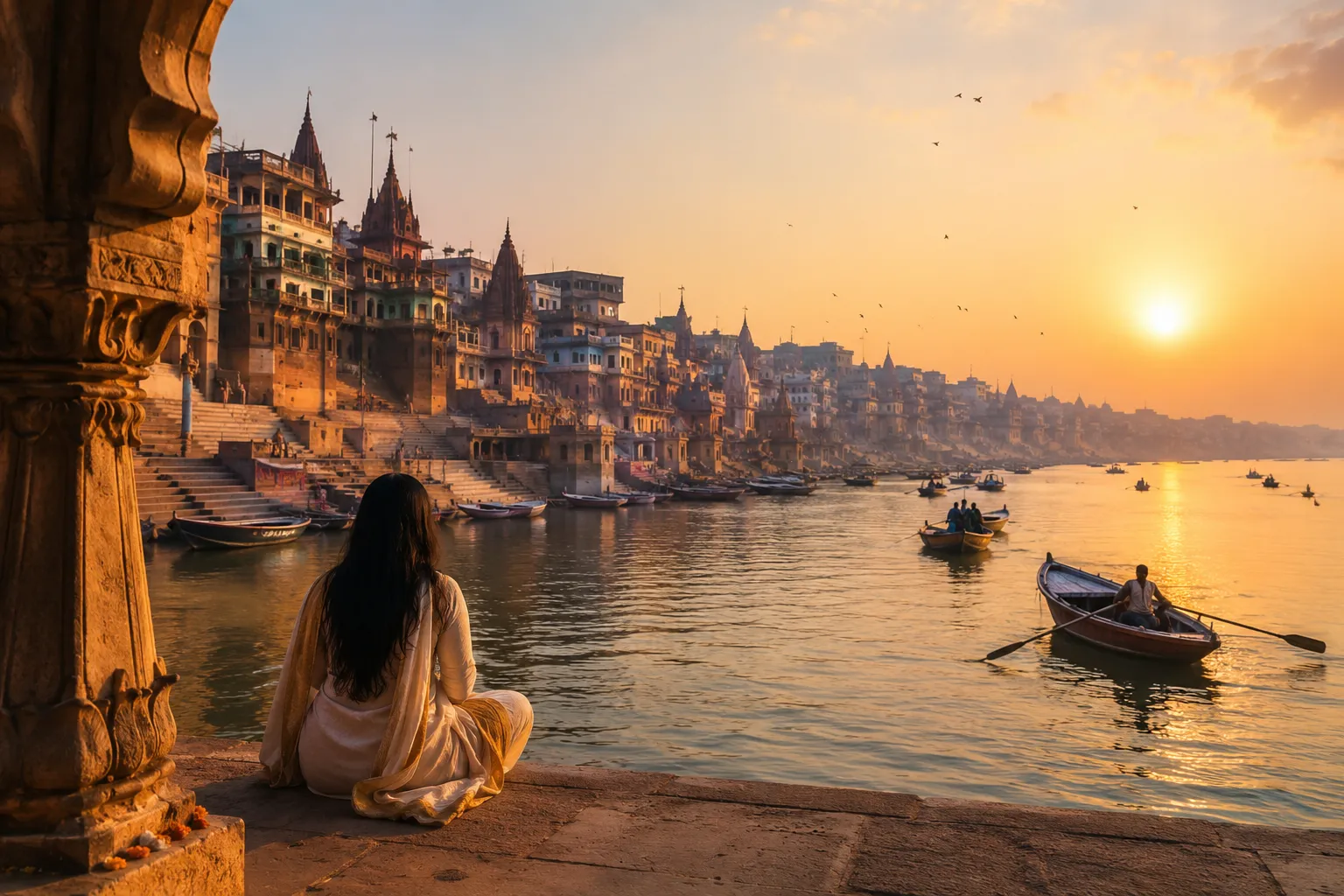
Varanasi doesn't really have a "downtown." It has a riverfront. Everything that matters here, the prayers, the fires, the boats, the chai stalls, the old men doing their morning stretches, happens on a long curved stretch of stone steps hugging the Ganga. Locals just call it "the ghats," like there's only one, even though there are dozens of them stitched together for almost four miles.
If you're planning a trip and typing "ghats in Varanasi" into Google at 1am trying to figure out what you're actually going to see, this guide is for you. We're not going to give you a dry list copied off Wikipedia. We've walked these steps more times than we can count, and honestly, some of what gets written about them online is either outdated or just plain wrong.
Before we get into it, if you'd rather skip the research and just have someone plan your Varanasi trip properly, say hi to our team and we'll sort it out for you.
So, How Many Ghats Are There in Varanasi, Really?
Here's where it gets a little messy, and no one seems to want to admit it. Most official sources, including the Varanasi city administration, count 84 ghats. That's the number you'll hear from guides, on government tourism pages, and in most books about the city.
But if you dig a bit deeper, you'll find the number isn't as fixed as people pretend. Some detailed surveys list 85 ghats. Older colonial-era records from the 1800s counted 87. And with the newly built Namo Ghat added to the riverfront in recent years, some current guides now say 88. A well-researched University of Kentucky archive from 2016 even lists 87 as the historical figure.
Why the confusion? A few reasons, honestly. Some ghats have been merged, renamed, or split apart over centuries of rebuilding. Others are so small and tucked away that older surveys just didn't bother counting them separately. And new construction, like Namo Ghat, keeps adding to the total. So when someone tells you "there are exactly X ghats in Varanasi," take it as a rough guide, not gospel. 84 is the number that's stuck in popular memory and the one you'll see most often, so that's the safest answer to give if someone asks you at a dinner party.
What's not up for debate is the scale of the thing. The ghats stretch roughly 6.8 kilometers (about 4 miles) along the western bank of the Ganga, from Assi Ghat in the south all the way up to Adi Keshava Ghat near where the Varuna river joins the Ganga. Most were rebuilt in their current stone form during the 18th century, funded by Maratha rulers, the Scindias, Holkars, Bhonsles, and the Maharajas of Benares. Before that, a lot of them were just mud banks. So when you're standing on those worn stone steps, you're mostly looking at 250-year-old construction, not something from the time of the Buddha, even though the city itself is far, far older.
Which Ghat Is the Most Famous in Varanasi?
If there's one clear answer to this, it's Dashashwamedh Ghat. No contest, really.
This is the ghat everyone means when they picture Varanasi in their head, priests in saffron robes swinging brass lamps in perfect sync as thousands of people watch from the steps and from boats bobbing on the river. The name comes from Sanskrit: "Dash" means ten, "Ashwa" means horse, and "Medh" refers to a sacrifice. According to legend, Lord Brahma performed a yajna here involving ten horses to welcome Lord Shiva to Kashi. Whether or not you buy the mythology, the ghat itself has serious history. It was rebuilt by the Peshwa Balaji Bajirao in 1740 and later restored again by Ahilyabai Holkar, the Queen of Indore, in 1774. That's the structure you're standing on today.
The famous Ganga Aarti happens here every single evening without fail, starting right around sunset and running for about 45 minutes. Timings shift a bit with the seasons, roughly 7 PM in summer when the sun sets later, closer to 6 PM in winter. It's free to watch, though seats and boat spots fill up fast, so get there early if you actually want to see something instead of the back of someone's phone. We've got a whole breakdown of exact timings and how to plan around them on our Ganga Aarti timing guide, worth a read before you go.
It also helps that Dashashwamedh sits just a five to ten minute walk from the Kashi Vishwanath Temple, one of the twelve Jyotirlinga shrines and arguably the most important Shiva temple in India. A lot of pilgrims take a dip here first thing in the morning before heading to the temple, which is actually the traditional order of things. If you're planning your temple visits around this, check our guide on Varanasi temple timings so you don't show up to a closed gate.
One thing that surprises first-timers: Dashashwamedh isn't peaceful. It's loud, crowded, a little chaotic, and full of people trying to sell you flower boats, sitar performances, or a "special priest blessing." Trust us on this one, that energy is exactly the point. This is not a meditation retreat. It's the beating heart of the city, and it feels like it.
The Other Ghats That Actually Matter
Eighty-something ghats is a lot to cover, and honestly, most visitors don't need to see all of them. Here are the ones worth knowing about, and why.
Manikarnika Ghat
This is the main cremation ghat of Varanasi, and it's burned continuously for what locals say is thousands of years, though there's no way to verify a claim like that literally. Hindus believe that being cremated here breaks the cycle of rebirth and grants moksha, direct liberation. It's a working ghat, not a tourist attraction, and you'll see funeral pyres burning at almost any hour. Photography is strictly forbidden here, and people will get genuinely angry if you try. Watch respectfully from a distance, or better, from a boat on the river. Also, a quick warning locals give every visitor: ignore anyone near this ghat who approaches you asking for "donations for firewood for a poor family." It's a well-known scam.
Harishchandra Ghat
The second cremation ghat in the city, smaller and less visited than Manikarnika, but with its own quiet gravity. It even has an electric crematorium now alongside the traditional wood pyres, which tells you something about how the city is slowly modernizing even its oldest rituals.
Assi Ghat
The southernmost of the main ghats, and where the Assi river (now more of a small stream) meets the Ganga. According to legend, Goddess Durga threw her sword into the river here after defeating the demons Shumbha and Nishumbha, which is where the ghat gets its name. This is where you'll find the gentler Subah-e-Banaras morning ceremony, yoga sessions at dawn, devotional music, and a much calmer aarti than the evening spectacle at Dashashwamedh. It's also become something of a hangout for students and travelers, with cafes and guesthouses lining the lanes behind it. We've written a full piece on this one specifically because it deserves it, you can read more about Assi Ghat here.
Tulsi Ghat
Named after Tulsidas, the poet-saint who is believed to have written parts of the Ramcharitmanas near here in the 16th century. It's a quieter spot with a genuinely literary weight to it if you know the story.
Panchganga Ghat
The name means "five rivers," referring to the mythical confluence of five rivers at this point, though only the Ganga is visible today. Dominated by the Alamgir Mosque built on the site of an older temple, this ghat carries a layered, complicated history that's worth reading up on before you visit.
Man Mandir Ghat
Built by Raja Man Singh in 1585 and renovated later, this ghat has a beautiful stone observatory built by Jai Singh II in the 18th century, blending Rajput and Mughal architectural styles. It's one of the few ghats where you can see actual astronomical instruments still standing.
Scindia Ghat
Home to the famous "leaning Shiva temple," a temple that sank into the river due to the sheer weight of the ghat construction and now sits tilted at an angle, half submerged. It's oddly photogenic in a way that's hard to explain until you see it.
Chet Singh Ghat
A fortified ghat with real military history, this is where Raja Chet Singh fought British troops in 1781 in one of the more dramatic confrontations of that era. The current here is strong, so it's not recommended for bathing, but the fort walls are worth a look.
Namo Ghat
The newest addition to the riverfront, opened in recent years with modern amphitheater-style seating and better facilities. It's not steeped in centuries of myth like the others, but it's become a popular spot for locals in the evenings, and it's helping ease crowding at Dashashwamedh.
The Best Way to Actually See the Ghats
Walking is fine for a few ghats near Dashashwamedh, but the real way to understand this stretch of riverfront is from the water. A boat ride lets you see the ghats the way they were meant to be seen, as one long continuous scene rather than isolated stops.
Sunrise is genuinely the better time, whatever anyone tells you about the evening aarti being unmissable. Get on a boat around 5:30 to 6:30 AM depending on the season, and you'll catch the whole riverfront waking up. Priests doing their morning rituals, people bathing, laundry being beaten against stone, the light turning the sandstone buildings gold. It's quieter, cheaper, and honestly more moving than the evening crowd scene. A shared rowboat runs somewhere between 100 and 400 rupees per person, while a private boat for a small group usually costs 800 to 1,500 rupees total for about an hour to ninety minutes. Prices climb a fair bit around festivals like Dev Deepawali, so book ahead if you're visiting then.
Before You Go
There's no real substitute for standing on these steps yourself. Photos and lists, ours included, can only tell you so much about what it feels like to watch the sun come up over the Ganga while a priest chants a few feet away and a boatman hums an old song under his breath. Varanasi asks a bit of patience from first-time visitors. It's crowded, it's intense in places, and it doesn't try to be pretty for you. But give it a day or two on these ghats and it has a way of getting under your skin in the best way.
If you want help putting together a trip that actually covers the ghats properly, timed right, with a guide who knows which corners are worth lingering in, get in touch with us and we'll build it around you.