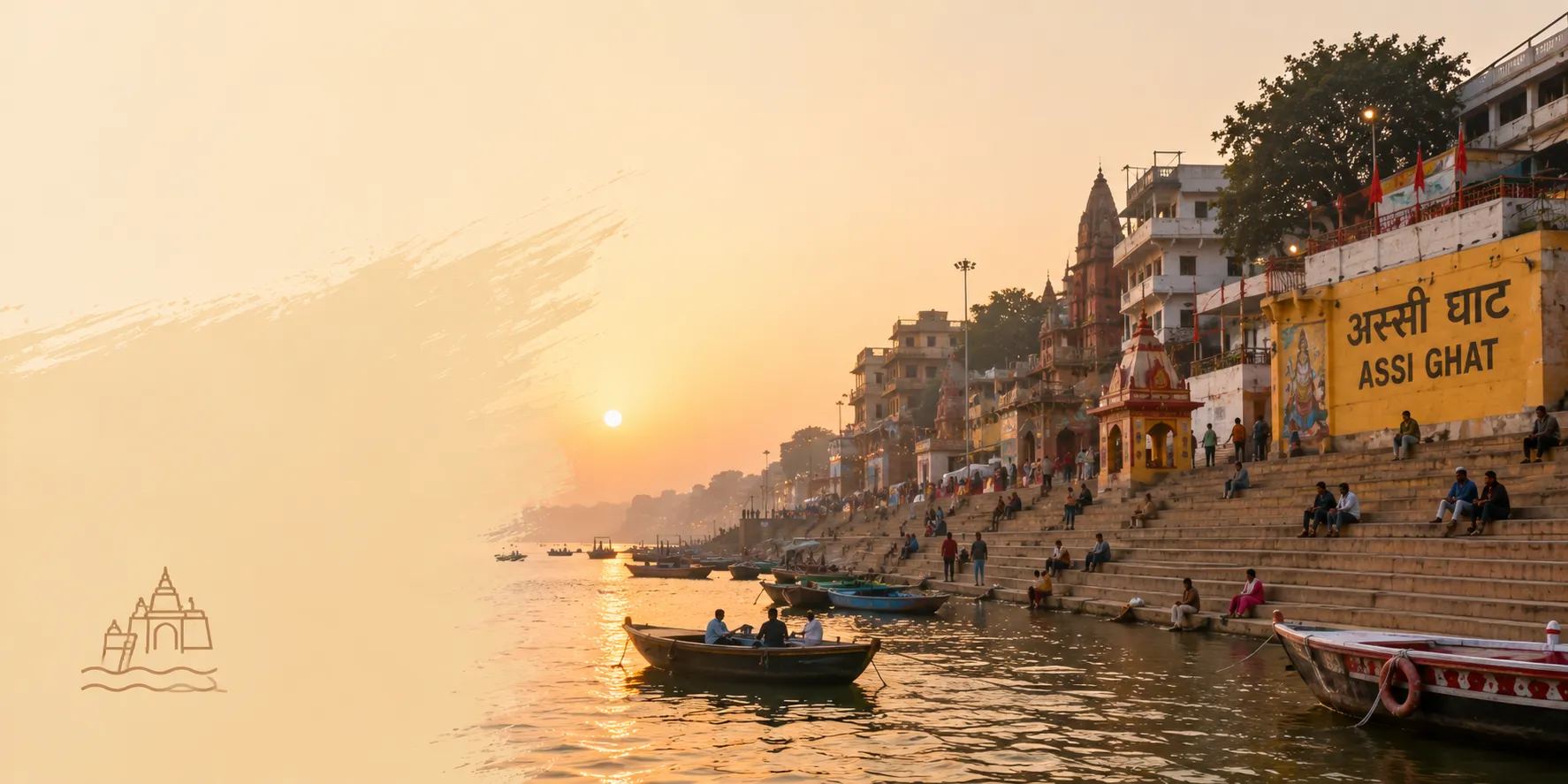
Ask anyone who actually lives in Banaras which ghat feels the most alive, and most of them will point you to Assi Ghat, not Dashashwamedh. Dashashwamedh is where the big evening Aarti happens and the crowds gather, but Assi Ghat is where the city actually breathes. It is where the day starts before sunrise with chanting and yoga, where students from BHU sit for hours with a cup of chai, and where foreign travellers end up staying for weeks instead of days without quite knowing why. This guide covers everything, history, timings, Subah-e-Banaras, boat rides, cafes and the small details that turn a quick visit into a real local experience.
Want someone who actually knows this ghat to plan your Varanasi mornings and evenings around it?
Talk to our travel desk and we will sort the whole thing for you.
Where Assi Ghat Is and Why It Matters
Assi Ghat sits at the southernmost end of Varanasi's riverfront, right where the small Assi river meets the Ganga. It is one of the five most sacred ghats in the Panchatirthi Yatra, the traditional five ghat pilgrimage circuit of Kashi, along with Dashashwamedh, Manikarnika, Panchganga and Kedar Ghat. Locals often call this area the Haridwar of Kashi, because of how sacred the confluence point is considered.
The name itself has a story behind it. According to legend, Goddess Durga threw her sword to the ground after defeating the demons Shumbha and Nishumbha, and a stream sprang up at that exact spot, which came to be known as the Assi river. Another version of the legend credits Lord Shiva with destroying eighty demons here, with "Assi" meaning eighty in Hindi. Either way, the ghat carries centuries of mythology, and it finds mention in ancient texts including the Matsya Purana, Kurma Purana and Padma Purana.
It was also here, tradition holds, that the poet Tulsidas spent his final years and wrote parts of the Ramcharitmanas, which adds another layer to why this stretch of the river feels so significant to locals.
Assi Ghat Timings
The ghat itself never closes, it is open 24 hours a day, every day of the year, and there is no entry fee to walk along it or sit on the steps.
The two events that actually decide when you should show up are the morning and evening Ganga Aarti.
Subah-e-Banaras (Morning Aarti and Cultural Program)
- Summer (March to October): Around 5:00 AM to 5:45 AM
- Winter (November to February): Around 5:30 AM to 6:15 AM
Subah-e-Banaras is not just an aarti, it is a full two hour cultural program that includes Vedic chanting, classical music performances, yoga sessions and a small ritual offering to the river, all happening as the sun comes up over the Ganga. It started in 2014 as an initiative by the local district administration to give visitors and residents a structured way to experience the spiritual side of Varanasi mornings, and it has since become one of the defining local experiences of the city.
Evening Ganga Aarti
- Summer: Around 6:30 PM to 7:00 PM
- Winter: Around 6:00 PM to 7:00 PM
The evening aarti here is quieter and less crowded than Dashashwamedh Ghat, which is exactly why a lot of long term visitors and locals prefer it. You get the same fire lamps, the same Vedic chanting, but with room to actually sit and watch without being packed shoulder to shoulder.
If you would rather build your evening around the bigger, more elaborate ceremony instead, our Ganga Aarti timing guide covers Dashashwamedh Ghat timings and viewing spots in detail.
What a Real Local Experience at Assi Ghat Looks Like
This is where Assi Ghat really separates itself from every other ghat in the city. It has a rhythm to it, and once you know that rhythm, your visit stops feeling like a tourist stop and starts feeling like you are actually part of the morning.
Early morning (5:00 AM to 7:00 AM): This is Subah-e-Banaras time, chanting, music and yoga on the steps as the sky turns pink over the river. Winter mornings here have a particular magic, mist rising off the Ganga, the smell of incense, and the first cups of chai being poured into small clay kulhads.
Mid morning: The ghat quiets down and turns into a place for a slow walk, a boat ride, or simply sitting and watching the river traffic, small fishing boats, the occasional buffalo wading in, priests going about their rituals.
Midday to afternoon: Students from Banaras Hindu University, which is only a short walk away, start showing up. This is when the ghat picks up its youthful, café culture energy, laptops, notebooks, long conversations over coffee.
Evening: The second Ganga Aarti of the day, followed by the ghat slowly filling up with locals out for an evening stroll and visitors settling into the rooftop cafés nearby.
If you only have one morning in Varanasi, spending it at Assi Ghat rather than rushing between temples is, in the opinion of most people who actually live here, the single best way to understand what this city is actually like.
Boat Rides from Assi Ghat
A sunrise boat ride from Assi Ghat is one of the most recommended things to do in the entire city. Boats set out just before or during Subah-e-Banaras, and drift slowly north past Tulsi Ghat, Bhadaini Ghat, and eventually toward Dashashwamedh, giving you a view of the ghats that you simply cannot get from land.
- Boats are available right from the ghat steps, early morning is when boatmen are most active
- A shared rowboat is the cheaper option, a private boat costs more but lets you set your own pace
- Prices are always worth confirming and gently negotiating before you get in, since there is no fixed government rate posted anywhere
- A one hour ride covering a handful of nearby ghats is usually enough for a first visit
Lolarka Kund
Tucked just behind Assi Ghat is Lolarka Kund, an old stepped water tank with its own religious significance. It is believed that childless couples who bathe here during the annual Lolarka Chhath festival are blessed with children, and the site draws devotees from across the region during that period. Even outside the festival, it is worth a short detour if you enjoy the quieter, lesser known corners of Varanasi's spiritual geography.
Best Cafes and Restaurants Around Assi Ghat
Assi Ghat has genuinely become a small café hub over the years, largely thanks to the steady stream of foreign students, researchers and long term travellers who end up living in the area. A few names come up again and again.
- Pizzeria Vaatika Cafe: Right on the river, known for wood fired pizza and one of the best sunrise views in the area
- Aum Cafe: A relaxed, colourful spot known for lemon pancakes, lassis and fresh bread
- Terracotta Cafe: An Australian-Indian fusion café known for good coffee and a farm to table style menu
- Ashish Cafe: A cosy, budget friendly place popular for its thali and Indian-Italian mix menu
Most of these sit within a short walk of the ghat, along what locals simply call Assi Ghat Road, and evenings here right before the aarti tend to be the busiest and most lively.
Festivals at Assi Ghat
The ghat comes alive noticeably during a few points in the year.
- Mahashivratri: Continuous chanting, meditation and prayer through the night
- Ganga Dussehra: A ten day festival marking the descent of the Ganga, bathing here is considered especially auspicious
- Dev Deepawali: The full moon night in November when the entire riverfront is lit with lakhs of earthen lamps, one of the most visually striking nights anywhere in India
- Lolarka Chhath: Centred around Lolarka Kund, drawing devotees seeking blessings for childbirth
If your trip dates line up with any of these, expect a much bigger crowd and a far more festive atmosphere than a regular day.
How to Reach Assi Ghat
- From Varanasi Junction (Cantt) railway station: Around 6 to 7 km, roughly 20 to 25 minutes by auto or cab
- From Varanasi Airport (Babatpur): Around 25 km, close to an hour depending on traffic
- From Banaras Hindu University: Just 1.5 to 2 km, an easy walk or a short auto ride
Autos, e-rickshaws and cabs all run regularly to Assi Ghat, and it is one of the easiest ghats in the city to reach since it sits at the edge of the main road rather than deep inside the narrow lanes like some of the others.
Best Time to Visit Assi Ghat
Best time of day: Early morning for Subah-e-Banaras and the sunrise, or evening for the Ganga Aarti and the café atmosphere. Both give you a completely different, equally worthwhile side of the ghat.
Best time of year: October to March, when the weather is cool enough for long walks and boat rides. Summer afternoons get uncomfortably hot, so if you are visiting between April and June, stick to the early morning or evening windows. Monsoon months, July to September, bring dramatically higher water levels, beautiful in their own way, but not the best time for boat rides or long walks along the steps.
If you are planning to cover Assi Ghat alongside the rest of the city's temples, our Varanasi temple timings guide will help you build the rest of the day around it.
Quick Tips for a Genuine Local Experience
- Arrive at least 20 to 30 minutes before Subah-e-Banaras starts to get a good seat on the steps.
- Carry a light shawl or jacket for winter mornings, the riverside gets cold before sunrise.
- Sit at a café for an hour without any plan, this is genuinely how most locals and long term visitors spend their time here.
- Negotiate boat prices before boarding, and confirm the route and duration upfront.
- If you want a quieter aarti experience than Dashashwamedh, the evening aarti here is the better choice.
Plan Your Varanasi Trip Around Assi Ghat
Assi Ghat has a way of becoming everyone's favourite part of Varanasi once they actually spend a morning there instead of just walking through. If you want your trip built around the right timings, the right ghat for each moment of the day, and a bit of local knowledge that only comes from actually living here, get in touch with our travel desk and we will put together a plan that fits your dates.