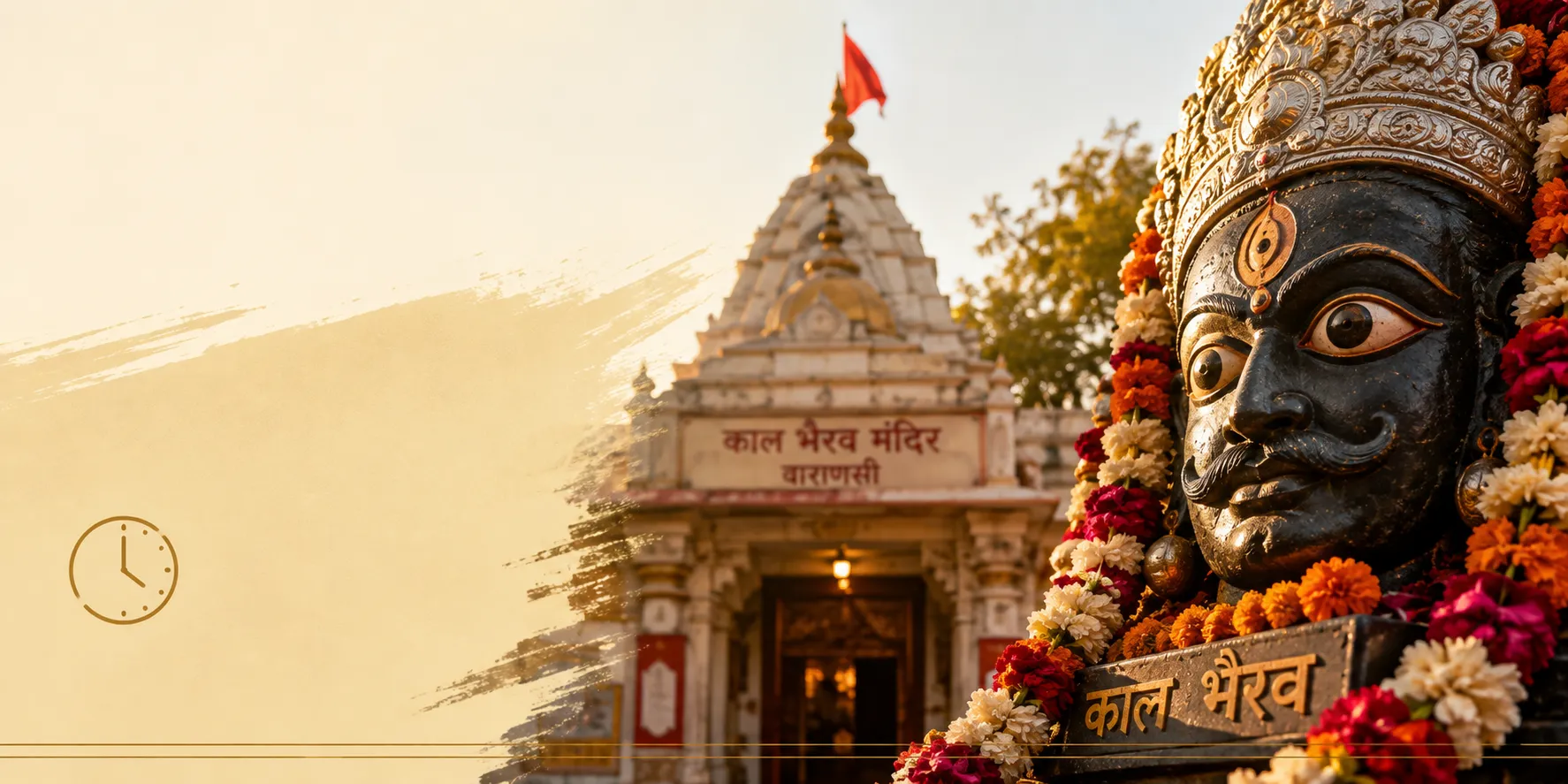
If you are planning a trip to Kashi, chances are Kaal Bhairav Mandir (also spelled Kal Bhairav Temple, or referred to as the Kalabhairava Temple) is already on your list, or it should be. Locals will tell you this is the temple you visit first, even before Kashi Vishwanath, because Kaal Bhairav is considered the guardian of the entire city. But the timings here are not as simple as "open all day," and getting them wrong can mean standing outside a closed gate during the afternoon break. This guide has everything you need: the daily schedule, aarti timings, address, special days, offerings, and a few things most other guides do not mention.
Planning your Varanasi trip and want the temple visits, timings and transport sorted for you?
We would love to help, just say hello to our travel desk and we will take it from there.
Kaal Bhairav Mandir Varanasi Timings
The temple runs on a split schedule: open in the morning, closed for a few hours in the afternoon, then open again in the evening.
Regular Days (Monday, Wednesday, Thursday, Friday, Saturday)
- Morning: 5:00 AM to 1:30 PM
- Afternoon Break: 1:30 PM to 4:30 PM
- Evening: 4:30 PM to 9:30 PM
Tuesday and Sunday
Tuesday and Sunday are considered the most important days for Kaal Bhairav worship, so the temple stays open longer and the crowd is noticeably bigger.
- Morning: 4:00 AM to 1:30 PM
- Evening: 3:00 PM to 10:30 PM
A quick note: temple gate timings in Varanasi are set by the temple trust and can shift slightly by season or on festival days. The afternoon break in particular has been reported anywhere from 1:30 PM to 3:00 PM, to 1:30 PM to 4:30 PM, depending on the day and time of year. If you're planning a visit around the break or late in the evening, it's worth a quick call ahead or checking with your hotel that morning.
Entry to the temple is completely free. There is no ticket for darshan.
Aarti Timings at Kaal Bhairav Mandir
The two aartis that matter most for planning your visit are the morning Mangala Aarti and the evening Sandhya Aarti.
- Mangala Aarti: Around 5:00 AM to 6:00 AM, right when the temple opens
- Sandhya Aarti: Around 8:00 PM to 8:30 PM
If you can only make it for one aarti, the Mangala Aarti in the early morning is the one most devotees consider special. It's quieter, the air is cooler, and the whole ritual feels far more personal than the evening rush.
Best Time to Visit Kaal Bhairav Mandir
Best time of day: Early morning, between 5:00 AM and 7:00 AM, right after the temple opens. This window has the shortest queue and gives you a calm, unhurried darshan. The evening window after 7:00 PM is the second best option, especially if you want to catch the Sandhya Aarti.
Best time of year: October to March, when Varanasi's weather is cool and pleasant enough to comfortably stand in line or walk through the narrow lanes leading to the temple. Peak tourist season falls between November and February, so if you want a quieter experience within those months, stick to the early morning slot.
Best days to visit: Sunday and Tuesday are considered spiritually significant for Kaal Bhairav, but they also bring the heaviest footfall. Monthly Kaalashtami and Mahashivratri also draw large crowds and extended hours. If you prefer a calmer visit, plan for any other weekday.
If you are trying to fit Kaal Bhairav Mandir into a wider temple circuit, our Varanasi temple timings guide covers Kashi Vishwanath, Annapurna, Sankat Mochan and a few others, all in one place, so you can plan the whole morning without any guesswork.
Where Is Kaal Bhairav Mandir Located
The temple sits in the Vishweshwarganj area of the old city, in the lanes near Kharikuwa and Ramapura Luxa, roughly 1 km from Kashi Vishwanath Temple and about 4 to 5 km from Varanasi Junction railway station. It's a well known landmark locally, so any auto or e-rickshaw driver in the old city will know it by name. You don't need the exact address to get there, but it's useful to have on hand if you're sharing your location with a driver or hotel:
D-47/223, Vishweshwarganj, Varanasi, Uttar Pradesh 221001
For the most authoritative overview of the temple's status and significance, the official Kashi web portal also lists Kaal Bhairav Temple among the city's most ancient and revered shrines.
History and Significance of Kaal Bhairav Mandir
The exact date the temple was first built is not recorded, but most historians place the current structure in the mid 17th century, with later renovation credited to the Maratha ruler Peshwa Baji Rao. Some sources also trace mentions of the site back to the Skanda Purana, underlining how old the tradition of worship here really is.
Kaal Bhairav is worshipped as a fierce form of Lord Shiva. The name itself carries the meaning: "Kaal" stands for both time and death, and "Bhairav" means the one who removes fear. So Kaal Bhairav is understood as the deity who frees his devotees from the fear of both death and time.
According to local belief, Lord Shiva appointed Kaal Bhairav as the Kotwal, or chief protector, of Kashi. Even today, people say that no soul can enter or leave the city without his knowledge, and it's a long standing custom to seek his blessing before visiting Kashi Vishwanath or before starting any important task in the city.
Inside the sanctum, the deity is represented by a silver faced image rather than a full idol, adorned with a garland of skulls and shown holding a trident, seated beside his vahana (vehicle), a dog. Only the garlanded face is visible to visitors through the doorway; the rest of the image stays covered with cloth. On the rear door of the temple there is also a separate icon of Kshetrapal Bhairav, another aspect of the deity, which many first time visitors miss. Devotees also visit the nearby Vishalakshi Temple, one of the Shakti Peethas, as part of the same pilgrimage circuit.
Rituals, Offerings and Dress Code
A few things make Kaal Bhairav Mandir different from most other Shiva temples in the city.
Offerings: Flowers, sweets and mustard oil are common offerings, but the temple is also known for accepting alcohol as a ritual offering, something you won't see at most other Shiva temples. This is a traditional practice here, not something visitors should be surprised by.
Feeding a dog: Since the dog is Kaal Bhairav's vahana, many devotees feed a dog (bread or a biscuit works fine) either before or after their temple visit as a form of seva.
Dress code: Modest clothing is expected, shoulders and knees covered. Carrying a scarf or dupatta is a good idea if you're unsure.
Footwear: Not allowed inside, so wear something you can slip on and off easily, and keep an eye on your slippers if you leave them outside.
Photography: Phones and cameras are generally restricted near the inner sanctum, so it's best to check with temple staff before taking any pictures.
Kaal Bhairav Ashtami, Jayanti and Mahashivratri Dates 2026
Kalashtami, also called Bhairav Ashtami, falls every month on the eighth day of the waning moon (Krishna Paksha Ashtami). Devotees fast and visit the temple in larger numbers on this day.
The most significant of these is Kaal Bhairav Jayanti, which in 2026 falls on Tuesday, 1st December, doubly auspicious since Tuesday is already considered a favourable day for Bhairav worship.
Mahashivratri is another major occasion here, drawing large crowds and often extended or night long temple hours, even though it's primarily associated with Shiva temples across the city rather than Kaal Bhairav specifically.
If your trip lines up with any monthly Ashtami, Mahashivratri, or Kaal Bhairav Jayanti, expect longer queues, extended temple hours and a much more festive atmosphere than a regular day.
How to Reach Kaal Bhairav Mandir
The temple is roughly 1 km from Kashi Vishwanath Temple and about 4 to 5 km from Varanasi Junction railway station, so most visitors combine both in a single outing.
- By auto or e-rickshaw: The easiest and most common way. Drivers know the temple well and can drop you close to the entrance.
- By cab: Convenient if you're coming straight from your hotel, though the last stretch through the narrow lanes usually has to be covered on foot.
- By foot: If you're already near Kashi Vishwanath or Vishwanath Gali, it's a short and easy walk.
Nearby Places to Combine With Your Visit
Since Kaal Bhairav Mandir sits right in the middle of the old city, it pairs naturally with a few other stops.
- Kashi Vishwanath Temple, about 1 km away, traditionally visited after Kaal Bhairav
- Vishalakshi Temple, one of the Shakti Peethas, near Manikarnika Ghat
- Annapurna Temple, just a short walk from Kashi Vishwanath
If you're also planning your evening around the river, our Ganga Aarti timing guide will help you time your visit to Dashashwamedh Ghat so the whole day, temples in the morning and aarti in the evening, flows together without any rushing around.
Quick Tips Before You Go
- Visit early morning for the shortest queue and the calmest atmosphere.
- Carry a scarf for modest dress, and wear footwear that's easy to remove.
- Keep some change handy for feeding a dog near the temple, a small but meaningful ritual here.
- If visiting on a Tuesday, Sunday, Ashtami or Mahashivratri, add extra time for the queue.
- Confirm the afternoon break and evening closing time locally if you're planning a visit around those windows, since they can shift by season.
Plan Your Kashi Darshan With Us
Kaal Bhairav Mandir is one of those temples that feels a lot more special once you know the timings, the rituals and the small customs that go with it. If you'd rather skip the planning and just show up ready for a smooth, well timed darshan, our team knows this city inside out. Tell us your travel dates and we'll build a temple itinerary around them: timings, transport and the whole route, sorted.