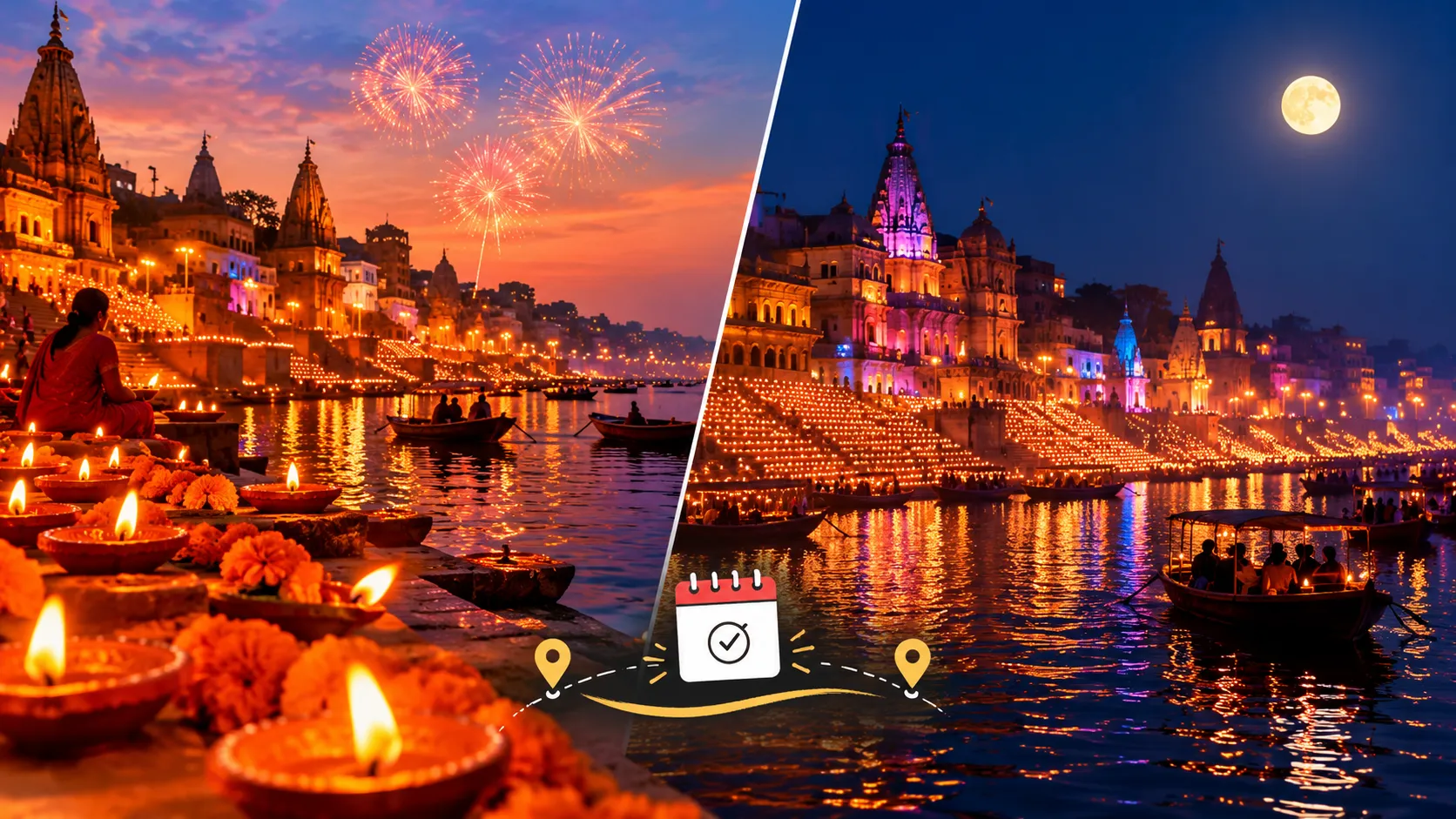
Many travellers arrive for Diwali in Varanasi expecting a million lamps on the ghats, then learn that the famous spectacle happens two weeks later. Diwali in Varanasi is a real festival, but the night that fills the riverfront with light is Dev Deepawali, on the full moon of Kartik.
In 2026, Diwali falls on Sunday, 8 November, and Dev Deepawali on Tuesday, 24 November. That is 16 days apart, so a single week cannot hold both main nights. This guide explains how the two festivals differ and gives you four practical ways to use a week in Varanasi.
Planning a Varanasi trip around either festival?
Talk to our team and we will help you choose dates and build a plan that fits.
Diwali vs Dev Deepawali at a Glance
| Diwali | Dev Deepawali (Dev Diwali) | |
|---|---|---|
| Lunar date | Kartik Amavasya (new moon) | Kartik Purnima (full moon) |
| 2026 date | Sunday, 8 November | Tuesday, 24 November |
| Story behind it | Lord Rama's return to Ayodhya, worship of Goddess Lakshmi | Lord Shiva's victory over the demon Tripurasura; gods are believed to descend to bathe in the Ganga |
| Where it is celebrated | Across India, mostly at home | Mainly on the Ganga ghats of Varanasi |
| Mood | Family puja, sweets, fireworks | Public, riverfront, aarti, lamps on ghat steps |
| Crowds in Varanasi | Moderate | Very heavy |
| Length | Five days, from Dhanteras to Bhai Dooj | One main night, with a build-up week |
How Diwali in Varanasi Feels
Diwali in Varanasi is mostly a home and temple festival. Families clean their houses, light diyas, and worship Lakshmi in the evening after sunset. Markets fill up with sweets, lamps and flowers, and the city looks festive. It is a lovely time to be here, but it is not a ghat-wide lighting event.
If your main goal is the biggest Diwali light show in the region, Ayodhya is set up for that. Its Deepotsav is organised by UP Tourism on a record-setting scale, usually around Chhoti Diwali, the day before Diwali. Dates are announced officially, so check before you book.
Varanasi does have one Diwali highlight that visitors rarely hear about. The golden idol of Goddess Annapurna at Annapurna Mandir is shown to devotees only around Annakut, from Dhanteras to the day after Diwali. Coins and rice grains are given as prasad. If you visit during Diwali week, this darshan is worth planning around.
The 2026 Diwali calendar looks like this:
- 6 November: Dhanteras
- 7 November: Choti Diwali
- 8 November: Lakshmi Puja, the main Diwali night
- 9 November: Govardhan Puja and Annakut
- 10 November: Bhai Dooj (a few calendars show 11 November)
Dates can shift by a day depending on the local panchang, so confirm with your hotel or guide.
How Dev Deepawali Feels
Dev Deepawali is the night of Kartik Purnima. According to tradition, Shiva defeated Tripurasura on this day, and the gods came down to Kashi to celebrate by bathing in the Ganga. Locals light lamps to welcome them.
The scale is what sets it apart. The ghats from Ravidas Ghat in the south to Rajghat in the north are covered in lamps, and reports from recent years put the count above a million, with about 17 lakh diyas across 84 ghats in 2024. The evening Ganga Aarti is bigger than usual, boats fill the river, and in recent years there has been a laser show near Chet Singh Ghat after the aarti. The same day is also Guru Nanak Jayanti, and many people take a dawn dip in the Ganga for Kartik Snan.
A date detail that confuses people: the Purnima tithi runs from about 11:42 PM on 23 November to 8:23 PM on 24 November. The lighting happens at dusk, roughly between 5:08 PM and 7:47 PM. You may see 25 November on a few websites, but the evening of 24 November is when the ghats light up.
Crowds are the trade-off. Reports put the 2024 turnout above 15 lakh visitors, and the main ghats become slow, packed corridors after sunset.
Why One Week Cannot Cover Both Main Nights
Dev Deepawali always comes fifteen tithis after Diwali. In 2026 that is 16 calendar days. So if you have seven days, you can build them around Diwali or around Dev Deepawali, but not both main nights.
The gap between them is not empty, though. A few things happen in Varanasi during those weeks:
- Chhath Puja, 13 to 16 November: Chhath is especially strong in eastern Uttar Pradesh and Bihar. The main evening offering is on Sunday, 15 November, at sunset (around 5:09 PM in Varanasi), and the morning offering is on 16 November at sunrise (around 6:17 AM). The ghats fill with families at both times, which is a moving sight but also means crowds and blocked steps.
- Prabodhini Ekadashi, 20 or 21 November: This is when Vishnu is said to wake from his sleep, and weddings resume. Ganga Mahotsav, a cultural festival on the ghats, usually begins around this date and runs up to Dev Deepawali.
- Akash Deep, through the month of Kartik: Lamps are hung high on poles above the ghats each evening until Kartik Purnima, so the riverfront slowly builds toward the final night.
Four Ways to Use Your Week
Option 1: A week that ends on Dev Deepawali (best for most travellers)
If you have to pick one, this is the plan we would suggest. You get the calm build-up days, the cultural festival, and the main night without rushing.
- Wed 18 Nov, arrive: Check in near Assi or Dashashwamedh. Watch the evening Ganga Aarti and keep the night easy.
- Thu 19 Nov, old Kashi: Take a sunrise boat ride, then visit Kashi Vishwanath, Annapurna Mandir and Kaal Bhairav. Walk the old lanes in the afternoon.
- Fri 20 Nov, Sarnath: Spend the morning at Sarnath, rest after lunch, and return to the ghats for the evening.
- Sat 21 Nov, Ganga Mahotsav: Check the official schedule for performances at Rajendra Prasad Ghat. Use the day for Banarasi silk shopping. Our Ganga Mahotsav guide explains what to expect.
- Sun 22 Nov, slow day: Walk between the ghats, take a break at a cafe, or cross the river for a quieter view. Notice how the decorations are starting to appear.
- Mon 23 Nov, prepare: Confirm your boat time and pickup point, explore early, and sleep well. The next day is long.
- Tue 24 Nov, Dev Deepawali: Take the dawn dip if you wish, rest in the afternoon, and head to the ghat by mid-afternoon. Board your boat around 4:30 PM so you are on the water when the lamps come on.
- Wed 25 Nov, depart: Leave in the morning, after the crowds have cleared.
Late November mornings in Varanasi are cool, around 12°C, and afternoons can reach about 25°C, so pack layers. Our Varanasi weather in November guide has more detail. If you would rather have logistics handled, For a closer look at what Dev Deepawali packages usually include, and how to compare them, read our Dev Deepawali package guide.
Option 2: A week around Diwali
Choose this if Lakshmi Puja, family time or the Annapurna darshan matters most to you. A simple layout: arrive on 5 November, see the golden Annapurna idol on 6 or 7 November, spend the evening of 8 November at your hotel or a quiet ghat for Lakshmi Puja, and visit the temple again for Annakut on 9 November. Add Sarnath and a morning boat ride on the days in between. If you want a bigger Diwali light show, add a day trip to Ayodhya for Deepotsav.
Option 3: Two shorter trips
This is the most realistic way to see both. Come for three nights around Diwali, roughly 6 to 9 November, then return for three or four nights from about 22 to 25 November. It costs more in travel, but each visit stays relaxed.
If you prefer to celebrate Diwali at home with family, you can do that and save Varanasi for the week before Dev Deepawali, following Option 1.
Option 4: One long stay
If you have 17 to 18 days, you can arrive around 6 or 7 November and stay until 25 November. This is the only way to see Diwali, Chhath, Ganga Mahotsav and Dev Deepawali in one trip. It suits photographers, writers, retired travellers and anyone who wants to live in the city rather than tour it. A slower pace, a homestay and a few day trips to Sarnath and Ramnagar keep the budget manageable.
Which One Should You Choose?
For most first-time visitors, Dev Deepawali is the better pick. Diwali can be enjoyed in almost any Indian city, while the riverfront lighting on Kartik Purnima is something Varanasi does like nowhere else.
Choose Diwali week instead if you want a quieter city, a family puja, or the Annapurna darshan. It is also easier on hotel prices and boat availability.
Practical Tips for Dev Deepawali Week
- Book early: Hotels near the main ghats and boats both fill up weeks ahead, and prices rise sharply close to the date. Our boat ride price guide explains what to expect.
- Choose your view: A boat gives the widest view of the lit ghats. Watching from the steps puts you closer to the aarti but in a dense crowd.
- Plan your walking: The stretch from Assi to Dashashwamedh is about 4 km, and it is slow going on the main night. Pick one section rather than trying to cover it all.
- Do not arrive on the day: Traffic near the old city is heavy, and late arrivals lose their boat slots.
- Leave the next morning: Crowds and vehicles thin out after sunrise.
- Dress modestly and keep valuables close: The ghats are packed and the steps can be uneven.
Conclusion
Diwali in Varanasi is a warm, quieter festival, while Dev Deepawali is the night that makes the city glow from one end of the river to the other. In 2026 they are 16 days apart, so the best use of one week is to pick one and plan it well. For most travellers, a week ending on 24 November gives you the calm days, the cultural build-up and the main night.