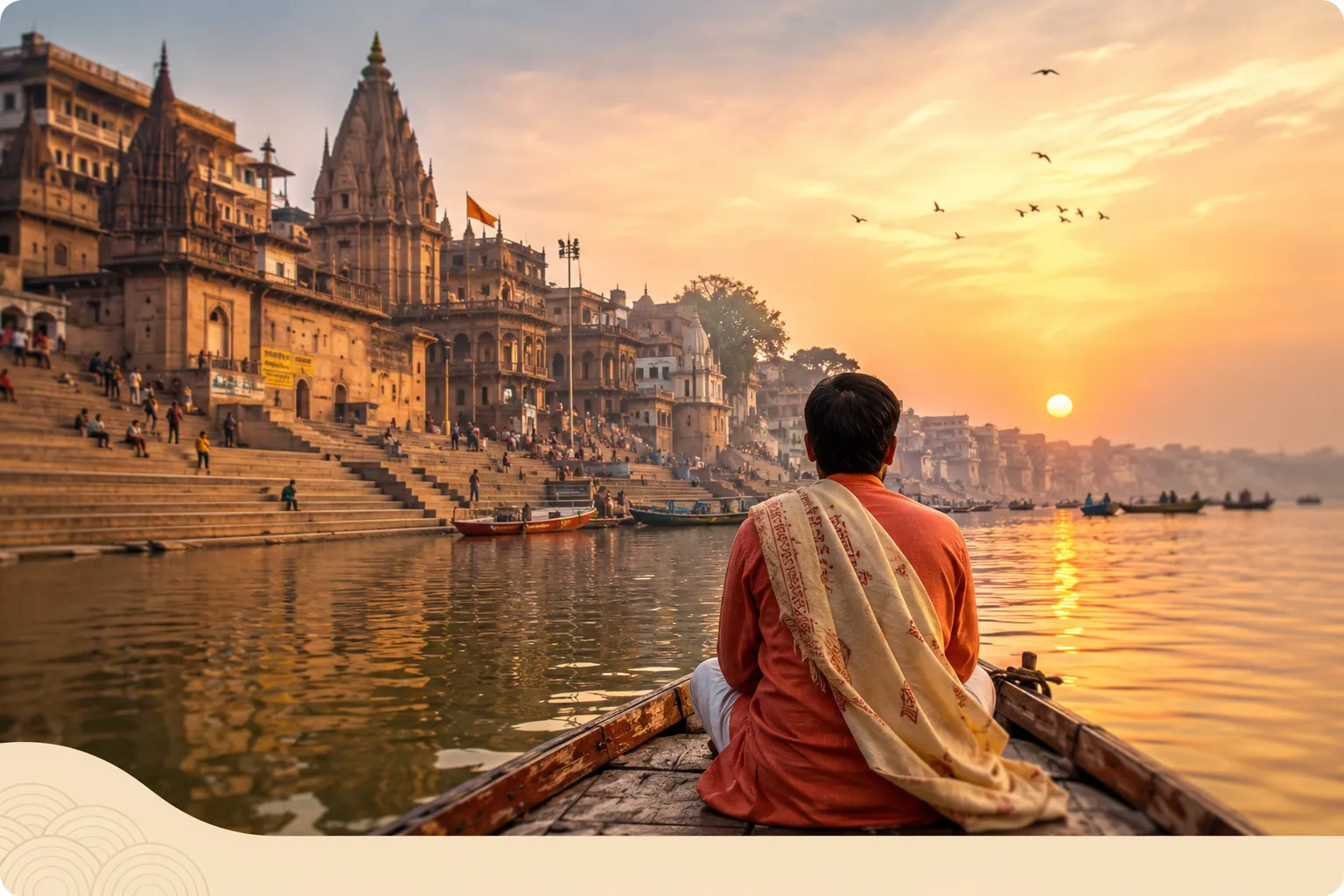
If you grew up in Tamil Nadu, Andhra, Telangana or Karnataka, you probably never called it a "Varanasi trip." It's Kasi. Your grandmother talked about going to Kasi one day. Your neighbour did a Kasi yatra last Pongal and came back with a bag of Banarasi sarees and a story about the aarti that she still tells at every family function. So when you type "kasi trip package" into Google at 11pm, you're not looking for a generic North India tourism guide. You want to know exactly how many days you need, how to actually get there from where you live, and what it's realistically going to cost you.
We've pulled that together here, with real numbers, not the vague "starting from" figures that most sites throw at you and never explain.
Quick note before we start: if you'd rather skip the research and just talk to someone who books this route every week, say hello to our team here and we'll sort out the dates and the darshan slots for you.
How many days does a Kasi trip actually need
This is the question almost nobody answers honestly. Most package pages just show you a 2N/3D option and a 6N/7D option and let you guess which one fits. Here's the real breakdown.
2 days (1 night): Doable, but tight. You'll cover Kashi Vishwanath temple, the main ghats, and one Ganga Aarti in the evening. You will not have time for Sarnath, and your morning boat ride will feel rushed. Honestly, this is the plan for people on a work trip who are squeezing in a darshan, not a proper Kasi yatra.
3 days (2 nights): This is the sweet spot for a first trip from South India, and it's why so many "kasi tour package from Chennai" listings are built around 2N/3D. You get one full day for the old city, temples and ghats, a second day for Sarnath and a relaxed boat ride, and enough breathing room that you're not sprinting between darshans.
5 to 6 days: This is when people combine Kasi with Ayodhya and Prayagraj, sometimes called the "Golden Triangle" of Uttar Pradesh, or add Gaya and Bodh Gaya for pind daan rituals. If your family is doing ancestral rites along with the yatra, budget at least 5 days because the Phalgu river rituals at Gaya and the Triveni Sangam visit at Prayagraj both eat up the better part of a day each, mostly in travel between cities.
Our honest advice: if this is your first Kasi trip and you just want the core experience done properly, go for 3 days. Save the 6-day multi-city version for when you're ready to make a full pilgrimage circuit out of it.
The route from South India: flight or train
Every operator will try to sell you the flight package first, because it's the higher-margin product. But depending on your budget and how much time you can spare, the train genuinely deserves a look, and it's something most guides barely mention.
By flight
There's no reliable daily direct flight from Chennai, Bangalore or Hyderabad straight into Varanasi. Most routes connect through Delhi, Hyderabad or Kolkata, and total travel time usually runs between 4 and 6 hours depending on the layover. One-way fares from Chennai typically start around ₹5,000 to ₹8,000 in economy on a normal day, climbing well past that during Diwali, Mahashivratri or the December wedding season. Flying is the obvious choice if you're short on leave days and want to land, do the darshan, and be back at your desk by Monday.
By train
If you're travelling from Tamil Nadu or coming via Kanyakumari, Madurai or Chennai, there's actually a train built specifically for this route. It's called the Kashi Tamil Sangam Express (train numbers 16367/16368), and it runs weekly between Kanyakumari and Varanasi (Banaras), covering roughly 2,766 km in about 51 hours, stopping at Madurai, Chennai and other major junctions along the way. It was flagged off in December 2023 as part of the Kashi Tamil Sangamam cultural programme, and it's a proper long-distance train with sleeper, AC 3-tier, AC 2-tier and even AC First Class options, so you can pick your comfort level.
There's also an older, separate service, the Rameswaram-Banaras Express (22535/22536), which covers a similar distance in around 49 to 51 hours and runs weekly too.
Train fares vary a lot by class, but you're realistically looking at anywhere from under ₹1,000 for a sleeper berth up to ₹5,000 or more for AC classes, one way. It's slow, two full days on the tracks, but for many pilgrims that's part of the experience, not a downside. Trust us on this one: the shared meals, the temple talk with strangers in your coupe, and watching the country change outside your window for two days is its own kind of yatra prep.
If you want the comfort of a flight but the completeness of a full multi-city package, we build those exact combinations. Our Varanasi tour packages cover both flight-based short trips and the longer train-friendly itineraries, depending on what suits your group.
What a Kasi tour package actually costs in 2026
Prices swing hard depending on how you travel, how many days you take, and what class of hotel you pick. Based on current listings and packages being sold from South Indian cities right now, here's roughly where things land.
Budget, train-based, 2N/3D: Somewhere around ₹9,999 to ₹18,500 per person. These usually include a shared AC deluxe room, basic sightseeing, and a group tour guide. Flights and higher-end hotels aren't included.
Mid-range, flight package, 2N/3D to 3N/4D: Around ₹21,500 to ₹30,900 per person. This tier usually bundles return flights, AC deluxe hotel stays, a Tamil or Telugu speaking guide, boat charges for the Ganga Aarti, and local transport.
Premium, multi-city, 5N/6D: Roughly ₹27,500 to ₹39,900 per person, sometimes touching higher figures if it includes Gaya, Ayodhya and Prayagraj together with a 5-star stay and VIP darshan arrangements.
A few costs almost never show up in the headline package price, so budget separately for these:
- Sugam Darshan (skip-the-queue entry) at Kashi Vishwanath Temple: priced somewhere between ₹250 and ₹300 per person as of 2026. You'll see both figures quoted across different sources, so don't be surprised if the exact number shifts a little. Book it on the official temple portal, not through a random tout outside.
- Special aartis like Mangla Aarti: these run higher, often around ₹500 per person, and need advance booking, especially in Shravan month when queues balloon to 4 to 6 hours.
- Ganga Aarti boat ride: cost depends on group size and whether you go at sunrise or during the evening aarti. Evening slots near the main ghat cost more because everyone wants that view.
- GST: most operators add roughly 5% on top of the quoted package price, so ask upfront rather than getting surprised at checkout.
A realistic 3-day Kasi itinerary
Day 1
Arrive in Varanasi, check into a hotel near Sigra or Godowlia, both areas keep you within walking or short auto distance of the ghats. Rest through the afternoon since the city's energy takes some getting used to. Head to Dashashwamedh Ghat by early evening for the Ganga Aarti. It's loud, crowded and genuinely moving all at once.
Day 2
Early morning boat ride on the Ganga, this is non-negotiable, the light on the ghats at sunrise is something photos never quite capture. Follow it with darshan at Kashi Vishwanath Temple, then visit Annapurna Devi temple and Kaal Bhairav temple nearby. Afternoon free for the narrow lanes and Banarasi silk shopping. Evening, either repeat the aarti from a different ghat or just sit quietly by the river.
Day 3
Morning trip to Sarnath, about 30 minutes from the city centre, where Buddha delivered his first sermon. The Dhamek Stupa and the museum are worth the slower pace after two intense days in the old city. Head back for lunch, wrap up any remaining shopping, and depart.
If you're extending to 5 or 6 days, add Ayodhya (Ram Janmabhoomi, Hanuman Garhi, Kanak Bhawan) as a separate day trip or overnight stop, and Prayagraj for the Triveni Sangam if you want the full circuit.
Why we built this guide differently
Most Kasi tour package pages you'll find right now are copy-pasted across dozens of city-specific URLs with the same three paragraphs swapped in and out. You've probably noticed it too if you've opened five tabs comparing packages, they all read suspiciously similar. We wanted this guide to actually help you plan, not just rank for a keyword, so we dug into the real train schedules, cross-checked the darshan pricing across multiple current sources, and laid out the day-by-day math instead of a vague "customisable itinerary" line.
Whichever route and duration you land on, the trip is worth every bit of the planning headache. If you'd rather hand that headache to someone else, reach out to us here and we'll build the itinerary around your dates.